The Budapest Memorandum
Budapest
In 1991 Ukraine held the world's third-largest nuclear arsenal, yet could not launch a single missile. It gave the weapons up, and on 5 December 1994 in Budapest the US, the UK and russia signed a memorandum: to respect its borders and not to use force against it.
Timeline
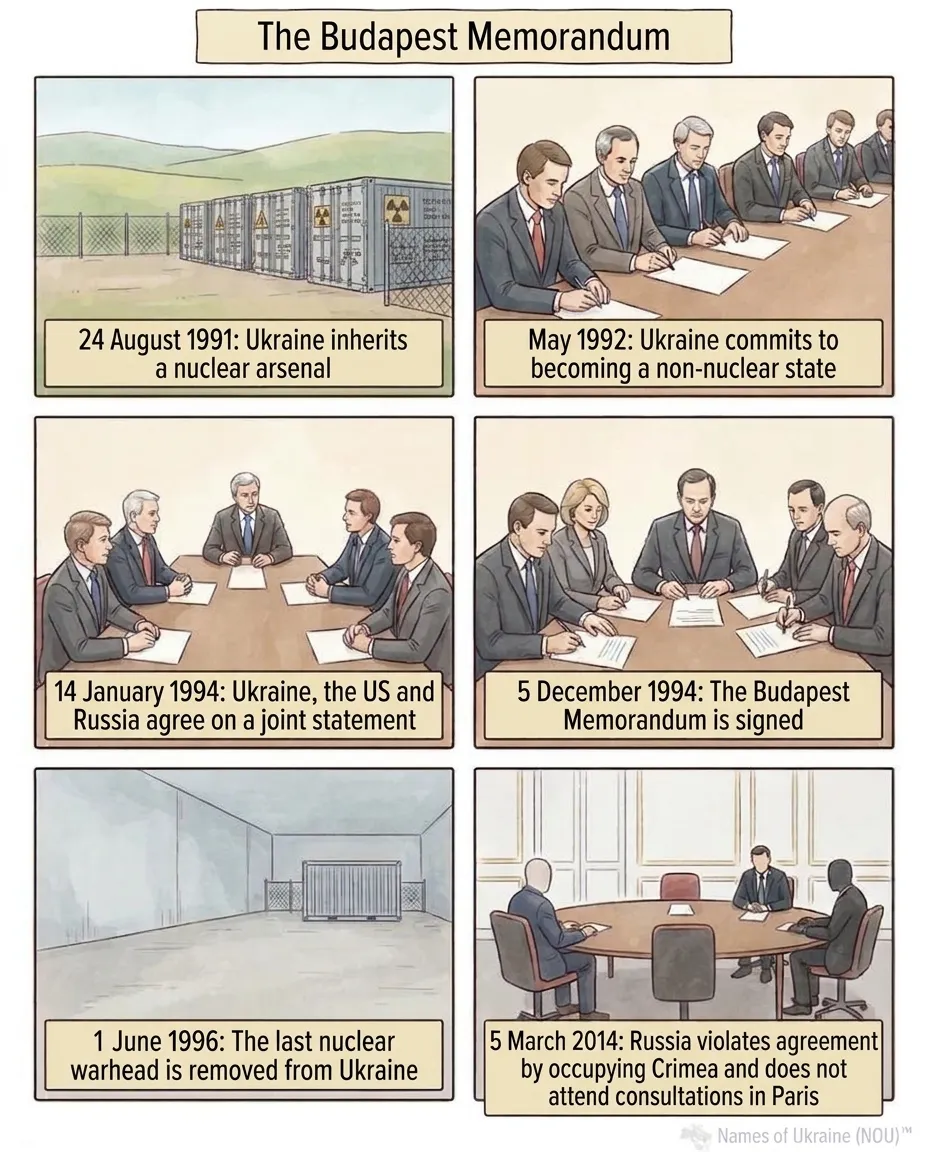
- 24 August 1991 Ukraine declares independence; about 1,900 strategic nuclear warheads remain on its soil
- May 1992 The Lisbon Protocol: Ukraine pledges to join the Treaty on the Non-Proliferation of Nuclear Weapons as a non-nuclear state as soon as possible
- 14 January 1994 The presidents of the US, russia and Ukraine sign the Trilateral Statement in Moscow
- 16 November 1994 The Verkhovna Rada passes the law on Ukraine's accession to the Non-Proliferation Treaty
- 5 December 1994 The Memorandum on Security Assurances is signed at the CSCE summit in Budapest
- 1 June 1996 The last nuclear warhead leaves Ukraine
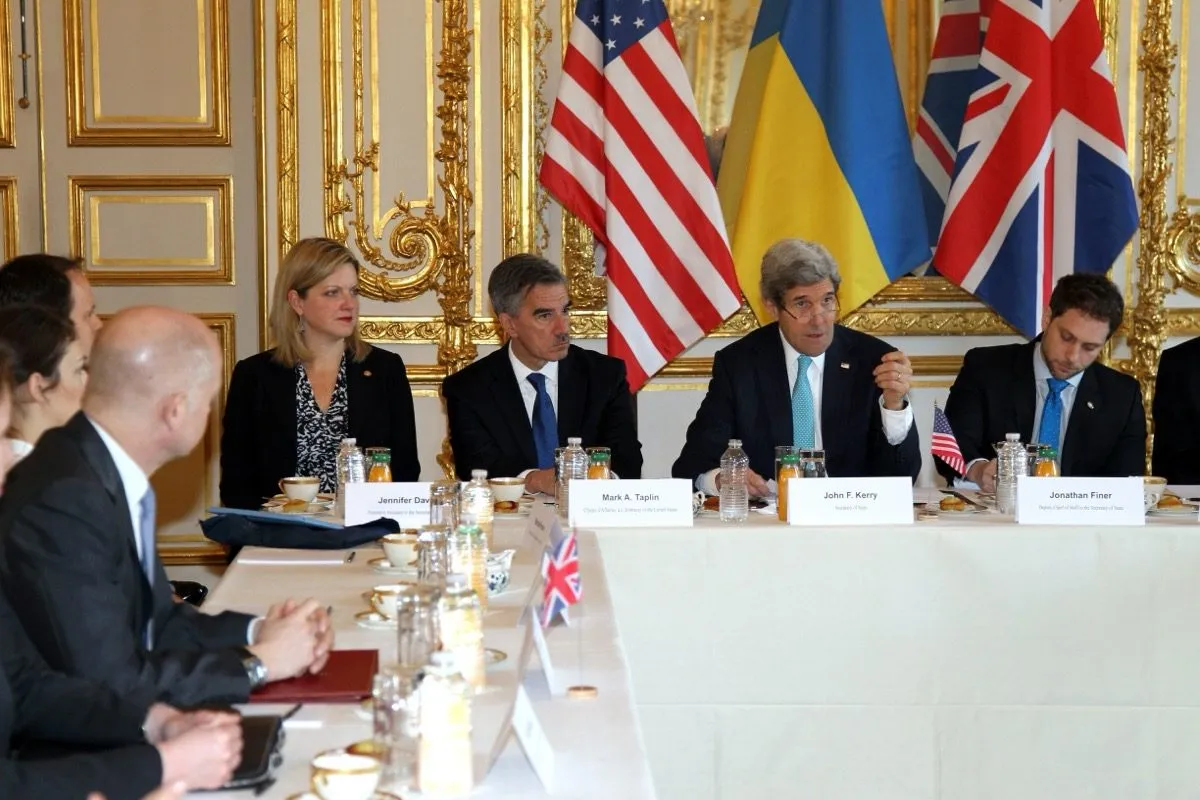
- 5 March 2014 After the occupation of Crimea the memorandum's parties meet for consultations in Paris for the first time; russia stays away
- 24 February 2022 The full-scale russian invasion of Ukraine begins
Imagine a country with the world’s third-largest nuclear arsenal that cannot launch a single missile. That was Ukraine after the Soviet Union fell apart. It gave the weapons up, and in return, on 5 December 1994 in Budapest, it got the signatures of three nuclear powers: the United States, the United Kingdom and russia. They promised to respect its independence and its borders. What exactly they promised, and what that paper is worth, is still argued over.
Weapons that could not be used
When Ukraine became independent in 1991, it was left with 176 intercontinental missiles, 44 strategic bombers, about 1,900 strategic nuclear warheads and thousands of tactical ones. But while the missiles stood in Ukraine, the launch codes and command stayed in Moscow. Ukraine could keep these weapons, but it could not use them.
As early as 1990, the Declaration of State Sovereignty had stated Ukraine’s intention to become a non-nuclear state. Even so, Kyiv did not want to hand the weapons over for nothing: what worried Ukrainian leaders most was that russia would not accept Ukraine’s borders, Crimea above all. In May 1992 in Lisbon, Ukraine, together with Belarus and Kazakhstan, promised to join the Treaty on the Non-Proliferation of Nuclear Weapons as a non-nuclear state as soon as possible.
What Ukraine got in return
On 14 January 1994 the presidents of the US, russia and Ukraine, Bill Clinton, Boris Yeltsin and Leonid Kravchuk, signed the Trilateral Statement in Moscow. Ukraine was compensated for the enriched uranium in the warheads with fuel for its nuclear power plants, received American money to dismantle the missiles, and was promised security assurances. On 16 November 1994 the Verkhovna Rada passed the law on joining the Non-Proliferation Treaty.
On 5 December 1994, at the summit of the CSCE (today’s OSCE) in Budapest, the memorandum was signed by Ukraine’s President Leonid Kuchma, US President Bill Clinton, British Prime Minister John Major and russia’s President Boris Yeltsin. Similar memoranda were signed for Belarus and Kazakhstan. France and China did not sign it, but gave Ukraine similar assurances in separate documents.
Six promises
The three nuclear powers reaffirmed that they would:
- “respect the independence and sovereignty and the existing borders of Ukraine”;
- refrain from the threat or use of force against its territorial integrity or political independence;
- refrain from economic coercion meant to bend Ukraine to their own interests;
- seek immediate UN Security Council action if Ukraine became the victim of aggression in which nuclear weapons are used;
- not use nuclear weapons against Ukraine as a non-nuclear-weapon state party to the Treaty.
The sixth promise bound all four parties: they “will consult in the event a situation arises that raises a question concerning these commitments.” The memorandum took effect on signature, with no ratification. On 1 June 1996 the last nuclear warhead was taken out of Ukraine, and by 2001 the missile silos had been eliminated too.
2014 and 2022
The consultations were called for the first time only twenty years later. After russia occupied Crimea, US Secretary of State John Kerry, British Foreign Secretary William Hague and Ukraine’s acting Foreign Minister Andrii Deshchytsia met in Paris on 5 March 2014. Moscow did not come. The three countries said that russia was violating Ukraine’s sovereignty and territorial integrity. On 24 February 2022 russia launched its full-scale invasion.
Debates and assessments
The main argument is about what kind of document the memorandum is. It is not a ratified treaty, and it is considered a political rather than a legally binding commitment. The English text speaks of “assurances”, the Ukrainian one of guarantees. American negotiators explain that the word was chosen on purpose: Washington was not prepared to give legally binding guarantees. Ukrainian diplomats stress that Kyiv had sought guarantees, and in 2026 Serhii Kyslytsia, First Deputy Head of the Office of the President, also pointed to the gap between the texts in different languages.
Ukraine, the United States and the United Kingdom hold that russia violated the memorandum by occupying Crimea in 2014; Ukraine stresses that in 2022 russia violated it again with a full-scale war. Moscow denies breaking its commitments.
Views differ on the United States and the United Kingdom. The memorandum did not oblige them to defend Ukraine militarily: beyond their own promises to respect its borders, they were bound only to consult and to go to the UN Security Council in case of a nuclear attack. Former Ukrainian Foreign Minister Borys Tarasiuk described their conduct after 2014 as a lack of commitment that cannot be compared with russia’s violations. Some American experts urged Washington back in 2014 to support Ukraine politically, financially and with sanctions, so that such assurances would not lose their weight.
Non-proliferation scholars warn that if the violations go unpunished, states seeking nuclear weapons will conclude that assurances are worth nothing. In 2022 Ukraine’s Foreign Ministry concluded that agreements with russia do not work as long as it has the means and the will to break them, and called for a new, more reliable system of security guarantees.
Why it matters today
Ukraine kept its side of the bargain in full: it gave up every nuclear weapon left on its soil and destroyed the missile silos. The Budapest Memorandum showed what promises are worth without a mechanism to make them binding. That is why Ukraine today seeks not assurances but guarantees backed by force and law. And anyone who defends its borders stands up for what in 1994 was only promised on paper.