The Constitution of Ukraine
Kyiv, Verkhovna Rada of Ukraine
After almost a full day of debate, the Verkhovna Rada adopted the Constitution of independent Ukraine at 9:18 a.m. on 28 June 1996. Since then, the Basic Law has defined the state’s system, people’s rights and the limits of government power.
Timeline
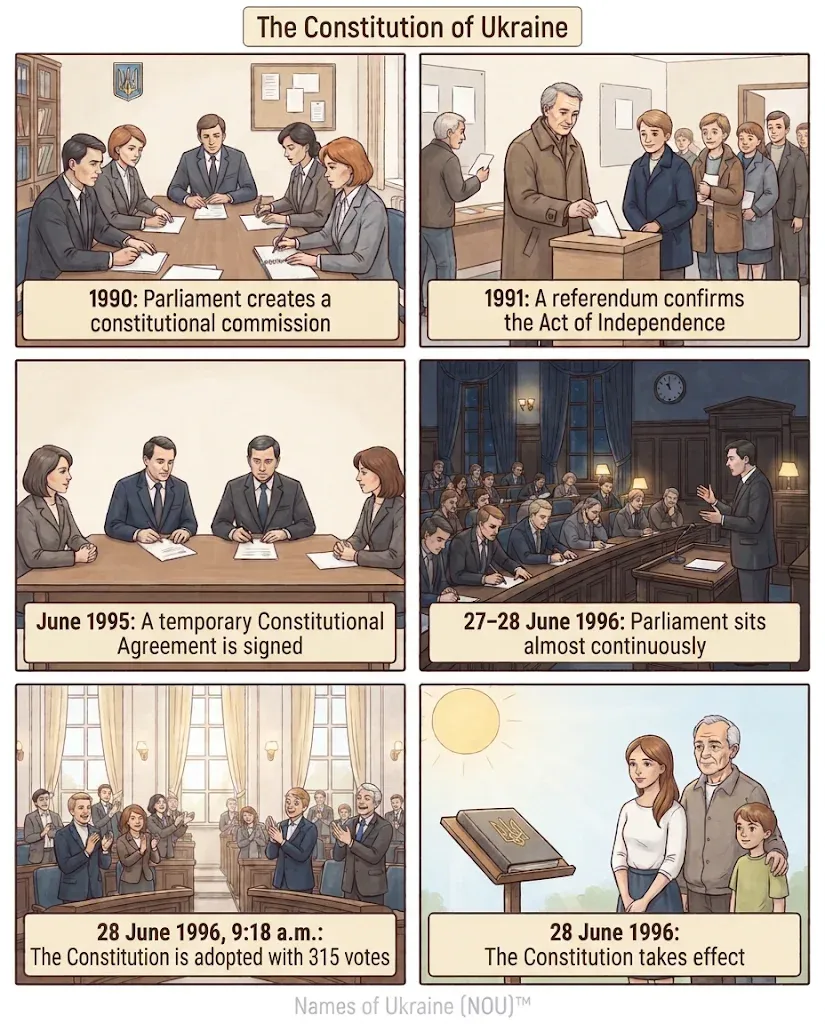
- 1990 The Verkhovna Rada creates a constitutional commission before independence is declared
- 1991 A nationwide referendum confirms the Act of Independence
- June 1995 The president and parliament sign a Constitutional Agreement as a temporary basis for government
- June 1996 President Leonid Kuchma signs a decree calling a referendum on his own draft for 25 September
- 27–28 June 1996 The Verkhovna Rada holds an almost continuous plenary session and adopts the Constitution with 315 votes
- 28 June 1996 The Constitution takes effect on the day it is adopted
Ukraine’s Constitution took shape during almost a full day in a crowded parliamentary chamber. At 9:18 a.m. on 28 June 1996, members of the Verkhovna Rada voted for the Basic Law of independent Ukraine.
Finding rules for an independent state
Ukraine was the last of the 15 former Soviet republics to adopt its own constitution: until 1996, the independent state lived under the 1978 constitution of Soviet Ukraine. Work on a new constitution began in 1990, while Ukraine was still a Soviet republic. After independence was declared, parliament continued drafting a Basic Law, but lawmakers disagreed over the powers of the president and parliament, state symbols, property and citizens’ rights. In June 1995, the president and parliament signed a Constitutional Agreement, setting temporary rules until a constitution could be adopted.
A night that became morning
Parliament came close to never passing it: a few days before the vote, President Leonid Kuchma signed a decree calling a nationwide referendum on his own draft for 25 September 1996. On 27 June 1996, the Verkhovna Rada began an almost continuous review of the draft. Lawmakers voted on articles and amendments, sought compromises and returned to disputed provisions. They adopted the Constitution at 9:18 a.m. on 28 June: it needed at least 300 of the 450 votes, and 315 deputies voted for it, with 36 against. It took effect immediately, the referendum decree was cancelled, and the adoption date became a national holiday.
The Basic Law defined Ukraine as a sovereign, independent, democratic, social and law-based state. It enshrined human rights and freedoms, the country’s territorial integrity and the separation of government into legislative, executive and judicial branches.
Debates and assessments
Adoption of the Constitution completed an important stage of state-building, but it did not settle every dispute over the balance of power. Parliament has amended constitutional provisions several times, and their interpretation has prompted political and legal debates. The Constitution is therefore both a document adopted that night and a living agreement that society continues to defend and discuss.
Why it matters today
The Constitution says government must serve people and act within the law. It protects rights that Ukrainians have repeatedly stood up for, and the independence the country is defending in war. Knowing the Basic Law means knowing what each person is entitled to and what the state is responsible for.