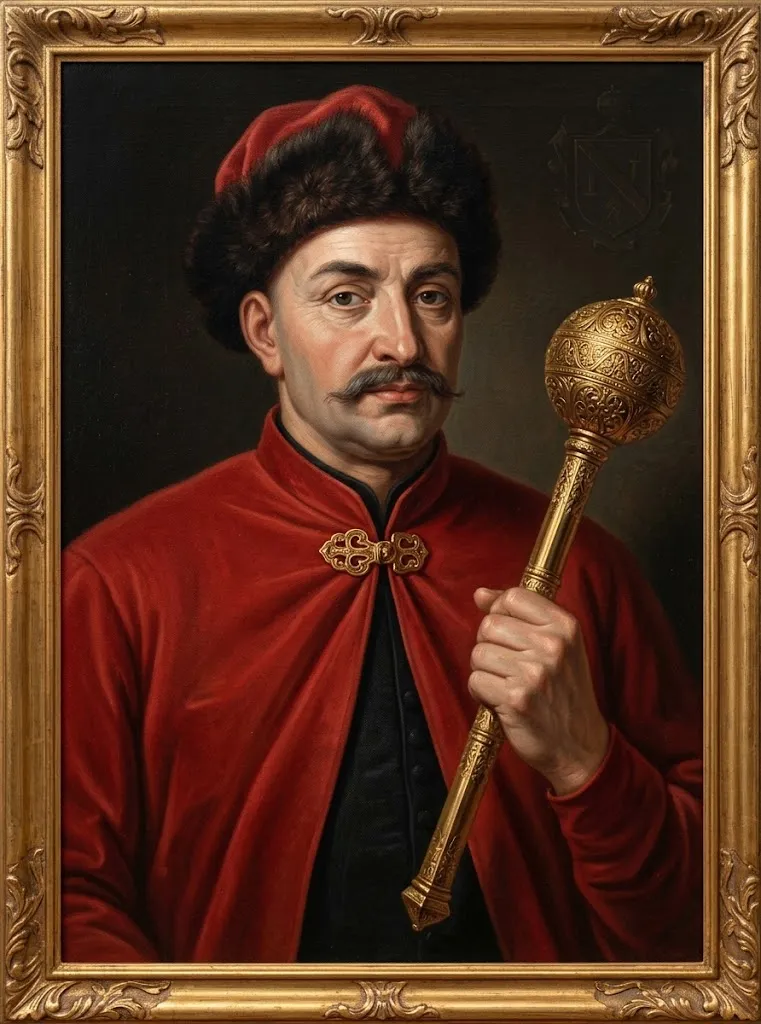
The Battle of Konotop
Konotop and Shapovalivka, Sumy region
In the summer of 1659, near Konotop, Hetman Ivan Vyhovskyi and his Crimean Tatar allies lured the tsar's cavalry into a trap on the Sosnivka River and destroyed almost all of it. Konotop made the victory possible by holding out for over two months. It could not be built upon.
Timeline
- September 1658 Vyhovskyi signs the Treaty of Hadiach with the Polish-Lithuanian Commonwealth; Moscow answers with war
- April 1659 Prince Aleksei Trubetskoi's army lays siege to Konotop; Colonel Hryhorii Hulianytskyi holds the town
- 4 July 1659 Vyhovskyi defeats the Muscovite vanguard near Shapovalivka
- 8–9 July 1659 The fight on the Sosnivka: Cossacks and Crimean Tatars surround and destroy Prince Semyon Pozharskii's cavalry
- July 1659 Trubetskoi lifts the siege of Konotop and retreats to Putyvl
- Autumn 1659 Vyhovskyi loses the hetman's mace; Yurii Khmelnytskyi becomes hetman
Can you defeat a huge army by damming a small river? In the summer of 1659, near Konotop, Hetman Ivan Vyhovskyi and his allies, the Crimean Tatars, lured the tsar’s cavalry into a trap on the marshy banks of the Sosnivka. Within a single day it was surrounded and almost entirely destroyed.
Why it happened
After Bohdan Khmelnytskyi died in 1657, Ivan Vyhovskyi became hetman. Moscow meddled more and more in the affairs of the Cossack state and backed his opponents. In 1658 Vyhovskyi signed the Treaty of Hadiach with the Polish-Lithuanian Commonwealth, and Moscow answered with war. In the spring of 1659 a large tsarist army under Prince Aleksei Trubetskoi marched into Ukraine.
The town that held out
In April 1659 the Muscovite army laid siege to Konotop. The town was defended by 4,000–5,000 Cossacks under Hryhorii Hulianytskyi, colonel of Nizhyn. The enemy was many times stronger: estimates range from 50,000 to 100,000 men. Yet Konotop held out for about 70 days. In that time Vyhovskyi gathered 16,000 Cossacks and hired troops from Poland, Moldavia, Wallachia and other lands, and 30,000–40,000 warriors of the Crimean khan Mehmed IV Giray came to his aid.
The trap on the Sosnivka
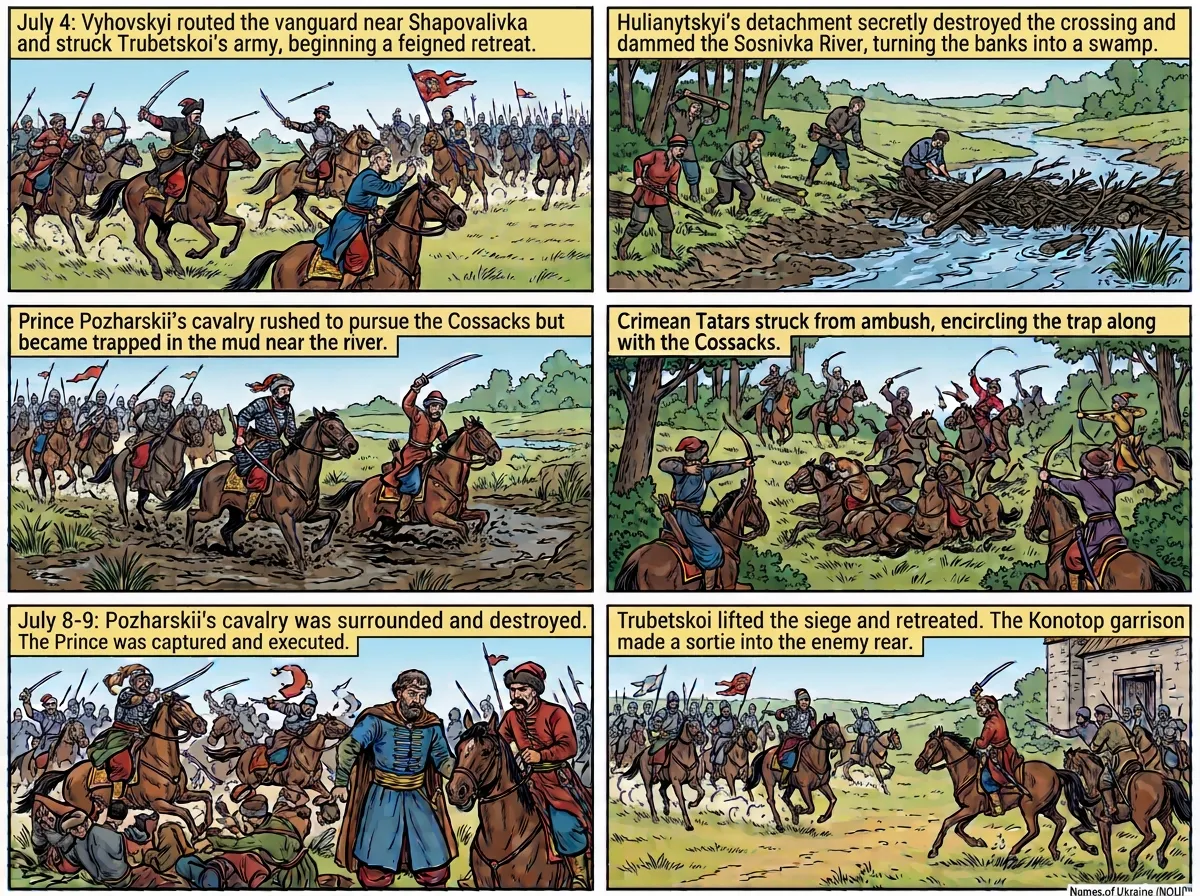
On 4 July (24 June, Old Style) Vyhovskyi defeated the Muscovite vanguard near the village of Shapovalivka and approached Konotop. The Cossacks struck Trubetskoi’s army and fell back, and Prince Semyon Pozharskii’s cavalry rushed after them: by some accounts, 30,000 horsemen. It crossed the Sosnivka River. Meanwhile a detachment under Stepan Hulianytskyi, the brother of Konotop’s defender, quietly destroyed the crossing and dammed the river, turning its banks into a marsh.
When the Cossacks pretended to retreat a second time, the Crimean Tatars struck from an ambush. On 8–9 July (28–29 June, Old Style) Pozharskii’s cavalry was surrounded and almost entirely destroyed; heavily armed riders sank and drowned in the marsh. The prince himself was captured and executed. Trubetskoi lifted the siege and retreated to Putyvl, and the Konotop garrison struck the withdrawing enemy. For three more days the Cossacks and Tatars pursued the Muscovites all the way to the border. In Moscow, people hurried to strengthen the city’s fortifications, and rumour spread that the tsar was leaving for beyond the Volga, beyond Yaroslavl.
How many died
There are no exact figures, and estimates differ widely. The most often cited are up to 30,000 Muscovites killed and between 5,000 and 15,000 taken prisoner. Some historians, drawing on Trubetskoi’s own reports, put the dead at almost 5,000. Many of the prisoners were put to death after the battle.
A victory that could not be built upon
Vyhovskyi could not make use of his victory. Moscow’s supporters on the Left Bank rose against him. Zaporozhian Cossacks led by Ivan Sirko raided the Tatar camps, and the khan hurried home to defend his own lands. In the autumn of 1659 Vyhovskyi lost the hetman’s mace, and Yurii Khmelnytskyi became hetman.
Why it matters today
Konotop showed that even a huge tsarist army could be beaten with cunning and reliable allies. Ukrainian Cossacks won this victory together with the Crimean Tatars. Imperial and Soviet histories long kept quiet about the battle, but independent Ukraine remembers it again: near Shapovalivka, where the fighting took place, stands a memorial for the battle’s 350th anniversary. Konotop is a reminder that Ukraine’s struggle against Moscow for the right to live its own way goes back a long time.