Pylyp Orlyk’s Constitution
Bender, Ottoman Empire (now Bender, Moldova)
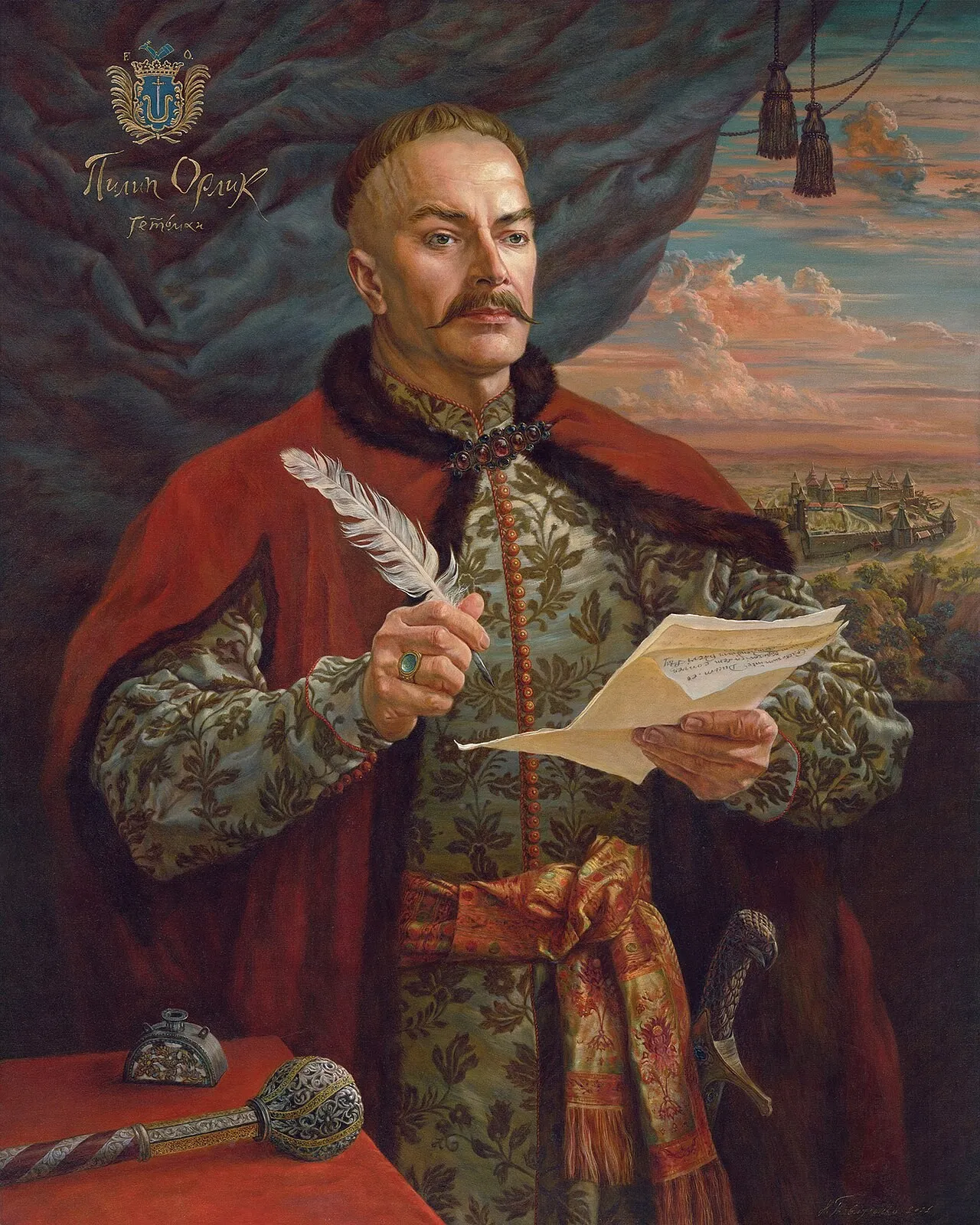
In exile, the Cossacks agreed to limit the hetman’s power. On 5 (16) April 1710, a council at Bender approved the pact known as Pylyp Orlyk’s Constitution. It set out the rights of the Zaporozhian Host and required the hetman to consult Cossack officers and Zaporozhian representatives.
Timeline
- 1708 Ivan Mazepa forms an alliance with Sweden’s King Charles XII
- 8 July 1709 After the defeat at Poltava, Mazepa, Orlyk and the Cossacks retreat to Ottoman territory
- 5 (16) April 1710 A Cossack council at Bender elects Pylyp Orlyk hetman and approves the Pacts and Resolutions on the Rights and Liberties of the Zaporozhian Host
- 1711 Orlyk leads a campaign into Right-Bank Ukraine in an attempt to restore the Hetmanate’s authority
- 1714–1715 Orlyk leaves Bender and reaches Sweden, where he continues seeking support for a Cossack state
Who owned the money Ivan Mazepa left behind? After he died in exile, Cossack officers and his heir disputed where Mazepa’s private property ended and the Host’s treasury began. That dispute raised a wider question about the next hetman’s power. In their agreement with Mazepa’s successor, the officers and Zaporozhians explicitly warned against letting the hetman make decisions on his own.
An agreement after defeat
On 5 April 1710 in the Julian calendar (16 April in the Gregorian calendar), a Cossack council at Bender elected the general scribe Pylyp Orlyk hetman. It approved the Pacts and Resolutions on the Rights and Liberties of the Zaporozhian Host (Pacta et Constitutiones Legum Libertatumque Exercitus Zaporoviensis). The agreement bound the hetman, the Cossack officers and the Zaporozhian Host. Kost Hordiienko, the Zaporozhians’ elected commander, signed on their behalf. Sweden’s King Charles XII later confirmed the pact as Ukraine’s protector.
The document had a preamble and 16 articles. The General Council was to meet three times a year, at Christmas, Easter and the feast of the Intercession. Its members included senior officers, colonels, advisers from the regiments and envoys from the Zaporozhians. An elected general treasurer was to manage the Host’s treasury, and the hetman could spend none of that money on himself.
The hetman had to protect people from excessive taxes and levies. The pact exempted Cossack widows and orphans from taxes and public duties and upheld towns’ rights. Other articles defined the Cossack state’s borders and called for the Orthodox see of Kyiv to return to the jurisdiction of Constantinople.
A state without its territory
In the spring of 1711, Orlyk led a campaign into Right-Bank Ukraine with support from Sweden, the Ottoman Empire and the Crimean Khanate. After early gains, he had to withdraw. Abroad, he continued to seek support for a Cossack state.
The pact had versions in Old Ukrainian and Latin. Latin was the language of European diplomacy and made the agreement accessible to foreign courts. An abridged Latin manuscript survives in Sweden’s National Archives in Stockholm. The Old Ukrainian original is held in the Russian State Archive of Ancient Acts in Moscow.
Debates and assessments
The document is called a constitution, pact or agreement. Calling it Europe’s or the world’s first constitution oversimplifies the history. Other countries had earlier legal acts, and in the early 18th century the Latin constitutiones could mean resolutions. What mattered at Bender was that the hetman accepted office on agreed terms and Cossack representatives could hold him to them.
Scholars differ on how far the pact took effect in Right-Bank Ukraine. Orlyk held parts of the region only briefly, giving the institutions outlined in the agreement little opportunity to take root.
Why it matters today
In exile, Cossack leaders kept pressing for independence and working out the rules for a future state. They agreed on who would manage public money and who could hold the hetman to account. Three centuries later, those questions still matter to anyone who entrusts people in power to act on their behalf.