The Chornobyl disaster
Chornobyl Nuclear Power Plant, Kyiv region
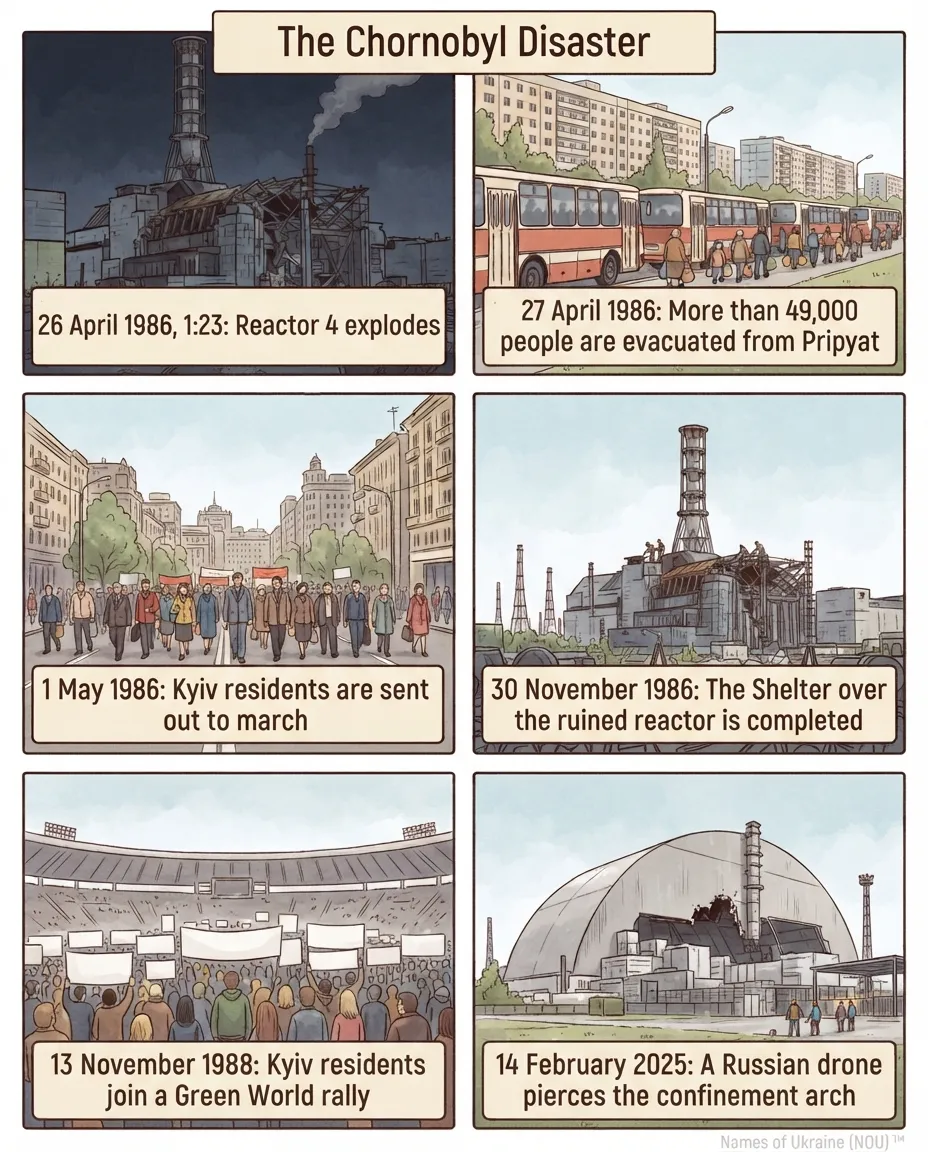
In the night of 26 April 1986 the reactor of Unit 4 at the Chornobyl nuclear plant exploded. Prypiat was evacuated only a day and a half later, and on 1 May Kyiv was sent out to march. Hundreds of thousands fought the disaster, and the truth about it helped push Ukraine towards independence.
Timeline
- 27 March 1986 Liubov Kovalevska criticizes the rushed construction of the plant in Literaturna Ukraina
- 26 April 1986, 1:23 a.m. During a test, the reactor of Unit 4 at the Chornobyl nuclear plant explodes
- 27 April 1986 Prypiat is evacuated: more than 49,000 people are taken out of the town
- 1 May 1986 The May Day march goes ahead on Khreshchatyk in Kyiv
- 30 November 1986 The Shelter over the destroyed unit is completed
- 13 November 1988 Tens of thousands of people in Kyiv join a Green World rally
- 15 December 2000 The Chornobyl plant is shut down for good
- November 2016 The arch of the New Safe Confinement is slid over the Shelter
- 24 February – 31 March 2022 The plant and the exclusion zone are occupied by russian troops
The explosion
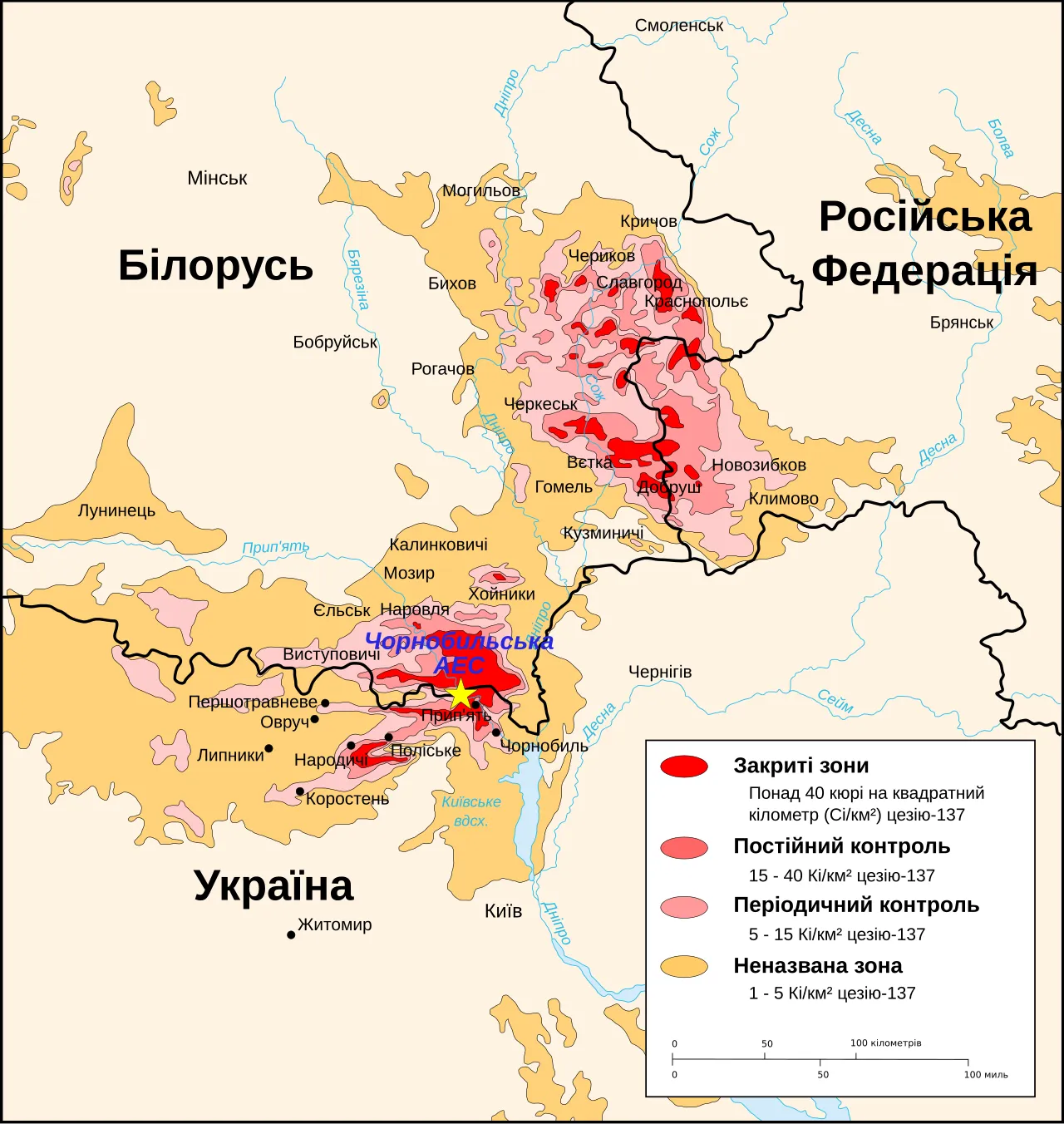
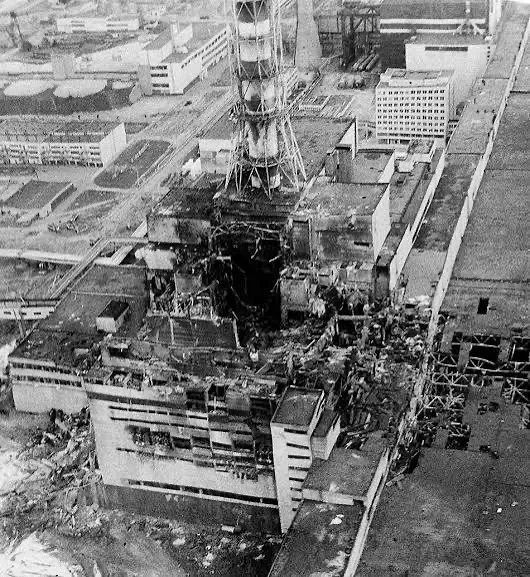
At 1:23 in the night of 26 April 1986, during a test at the Chornobyl nuclear power plant, 3 kilometres from the town of Prypiat, the reactor of Unit 4 exploded. On the international scale of nuclear events the accident was given the highest rating, level 7. The heaviest releases of radioactive material came in the first ten days, and they contaminated large areas of Ukraine, Belarus, russia and many countries in Europe. The unit had been completed only in 1983.
The night no one forgot
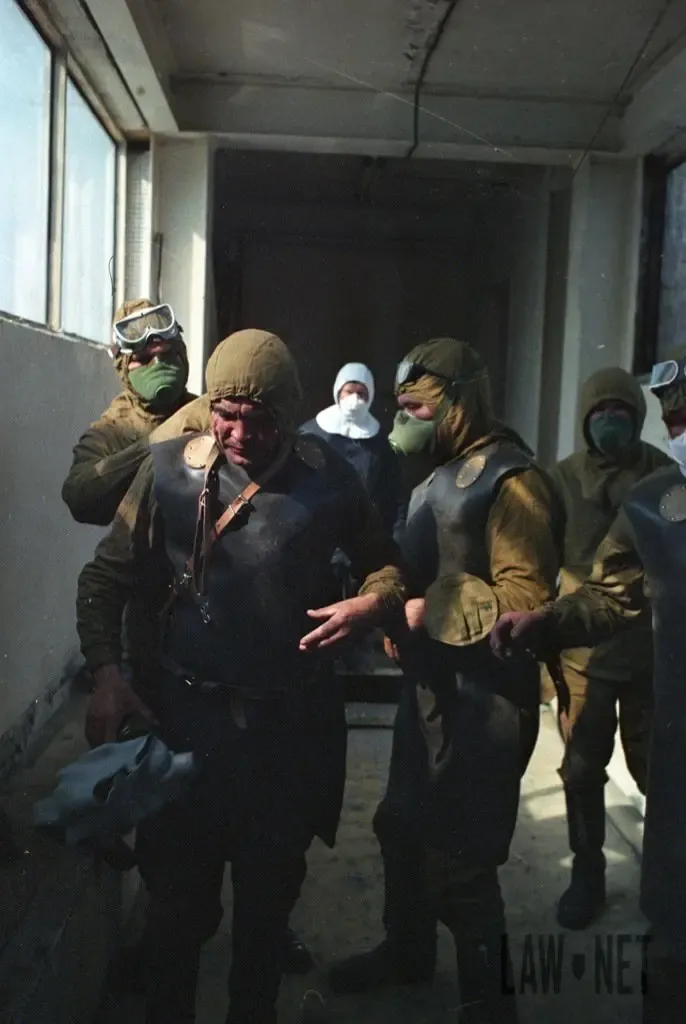
The accident is blamed on flaws in the design of the RBMK-1000 reactor and on serious breaches of how it was run. The flaws in how the plant was built had been written about before: on 27 March 1986, exactly a month before the explosion, the Prypiat journalist Liubov Kovalevska, in the article “Not a Private Matter” in the newspaper Literaturna Ukraina, criticized the shortcomings and defective materials in the construction of Unit 5, whose schedule had been cut from three years to two. By that morning two plant workers were dead: the operator Valerii Khodemchuk was killed under the rubble, and the technician Volodymyr Shashenok died of a fatal dose. Firefighters from the plant and from Prypiat, led by the heads of their shifts, Volodymyr Pravyk and Viktor Kibenok, had put out the fires on the roofs by morning, without knowing how dangerous the radiation was. Acute radiation sickness was found in 134 firefighters and plant staff; 28 of them died within a few months, many in Moscow’s Hospital No. 6.
The silence
No one told the people of Prypiat they were in danger, and the same day the plant director, Viktor Briukhanov, reported that the situation in the town was normal and radiation levels were under control. The evacuation began only on the afternoon of 27 April, about 36 hours after the explosion, and 49,360 people were taken out of the town. Meanwhile the KGB watched letters and international calls and fought “panic rumours”. The world learned of the accident on 28 April, when a spike in radiation was detected in Sweden, including at the Forsmark nuclear plant, and traced back to the USSR. Only that evening did the Vremya news programme read out the first official statement, which lasted 14 seconds, while the newspaper Radianska Ukraina gave the accident eight lines at the bottom of its editorial. On 1 May in Kyiv, 130 kilometres from the plant, people were sent out on the May Day march down Khreshchatyk. Schoolchildren were given tracksuits for the rehearsals, and the KGB later noted that the clothing had a high radiation level. On 6 May a stage of the international Peace Race cycling event ran down Khreshchatyk. On 5 May the leaders of the G7, meeting in Tokyo, urged the Soviet government to provide information about the accident without delay, and Mikhail Gorbachev first spoke about it on television only on 14 May. To avoid panic, no iodine was handed out, and people with radiation sickness were given other diagnoses. The contamination maps were kept secret until 1990.
The liquidators and the Shelter
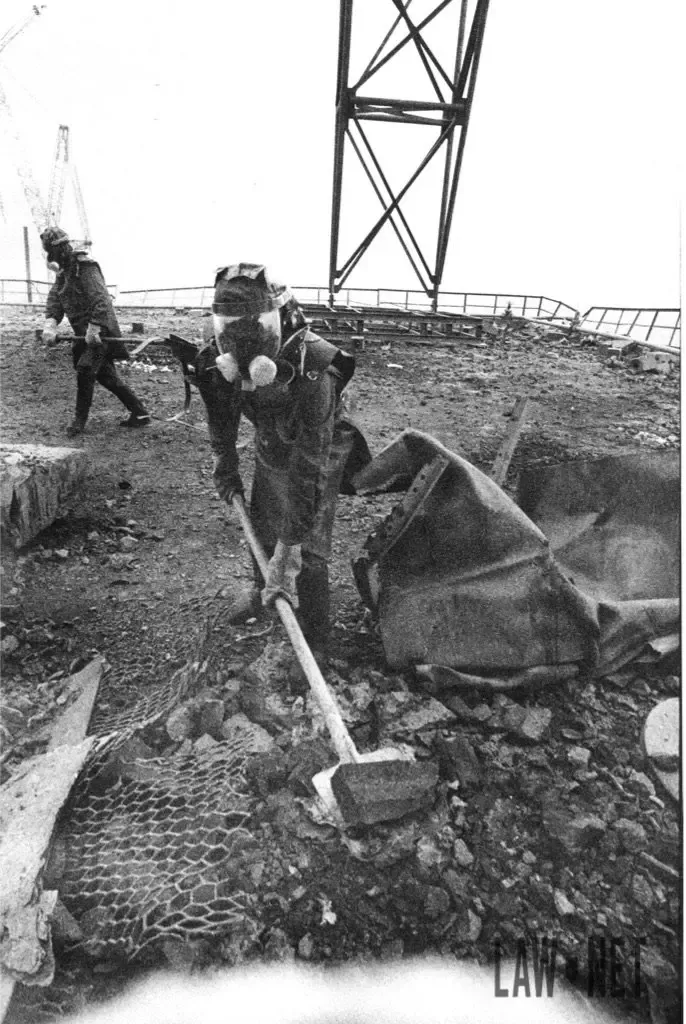
On 2 May it was decided to move people out of the 30-kilometre zone; by the end of 1986 about 116,000 people had left it. Water was still standing under the ruined reactor, and in early May the engineers Borys Baranov, Oleksii Ananenko and Valerii Bespalov went down into the flooded rooms and opened the valves to drain it. In all, sources put the number of people who worked to contain the disaster, the liquidators, at between 600,000 and 800,000, most of them young. Even once the radiation was known about, proper protection was lacking: the liquidators’ protective gear was often home-made. More photos from those days are in the photographer Ihor Kostin’s collection on BBC News Ukrainian. In 206 days a concrete Shelter, the “sarcophagus”, was built over the unit, and it was accepted for service on 30 November 1986. The physicist Ihor Yukhnovskyi later worked on the Shelter’s safety too.
How Chornobyl woke Ukraine
The cover-up and the May Day march destroyed people’s trust in the authorities. In December 1987 the Green World environmental association was founded. On 13 November 1988 tens of thousands came to its rally near the Republican Stadium, with banners against new reactors and against the empire. In September 1989 the People’s Movement of Ukraine, Rukh, was founded, led by the poet Ivan Drach, who later said it was Chornobyl that set off all the democratic changes in Ukraine. The disaster is seen as one of the things that drove the movement for independence.
The zone after the disaster
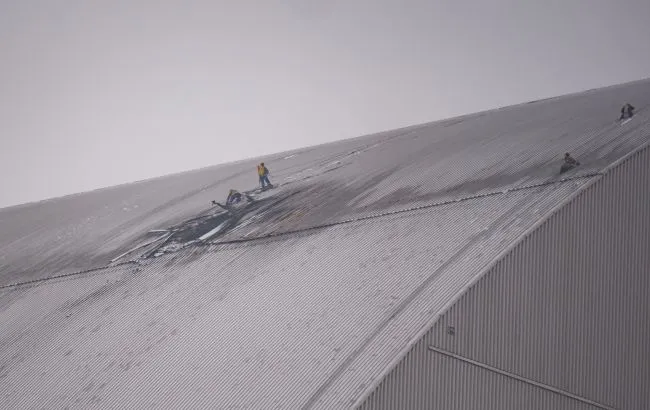
On 15 December 2000 the Chornobyl plant was shut down for good. In November 2016 the arch of the New Safe Confinement, weighing 36,000 tonnes, was slid over the old Shelter. It was designed to last at least a hundred years and paid for by more than 40 countries. On 24 February 2022, the first day of the full-scale invasion, russian troops seized the plant. On 31 March they handed control back to the Ukrainian staff in writing and left towards Belarus, leaving damaged laboratories and a mined zone behind. Ukrainian prosecutors are investigating the occupation as a war crime and have named suspects for looting the plant, among them a russian general and a Rosatom official; in 2022 they also opened proceedings under the ecocide article. On 14 February 2025 a russian attack drone punched through the arch, and it lost its full seal. The strike is being investigated as a war crime, and Ukraine’s nuclear regulator called it a deliberate act of terror. In December 2025 the IAEA found that the confinement had lost its main safety functions, including its ability to contain radioactive material. In April 2026, for the 40th anniversary of the disaster, the renewed exhibition of the National Chornobyl Museum opened in Kyiv, and on 24 May that year the museum was damaged by russian shelling.
Debates and assessments
How many lives Chornobyl took is still argued over. Two plant workers died at once, and 28 people died of acute radiation sickness within a few months. Long-term estimates vary widely. A UN report prepared with the IAEA and the WHO spoke of about 4,000 possible deaths from radiation-related cancer; Greenpeace put the number of extra deaths at up to 93,000, and other organizations gave figures from 50,000 to a million. The range is put down to how political the subject is and how hard it is to predict the effects of low doses of radiation. Counting is also harder because the Soviet authorities hid the effects of radiation: according to a KGB report of May 1986, Kyiv hospitals, citing an instruction from the Ukrainian SSR’s Ministry of Health, wrote “vegetative-vascular dystonia” in the records of patients with signs of radiation sickness, and statistics on radiation sickness were classified. Some researchers, including the historian Kate Brown, believe the true health effects of the disaster are still underestimated. At least 6,000 cases of thyroid cancer in children had been found by 2005.
Why it matters today
Chornobyl showed that the truth about danger is a matter of life and death, and that a government that hides it loses the right to be trusted. Firefighters, engineers and liquidators gave their health, and many their lives, to keep the disaster from getting worse. Anger at the hidden truth was one of the roots of the civic movement and of an independent Ukraine. The occupation of 2022 and the strike on the confinement are a reminder that the threat of a nuclear disaster is not only in the past. Anyone who demands the truth from those in power carries on what people began in the 1980s.