1899–1937
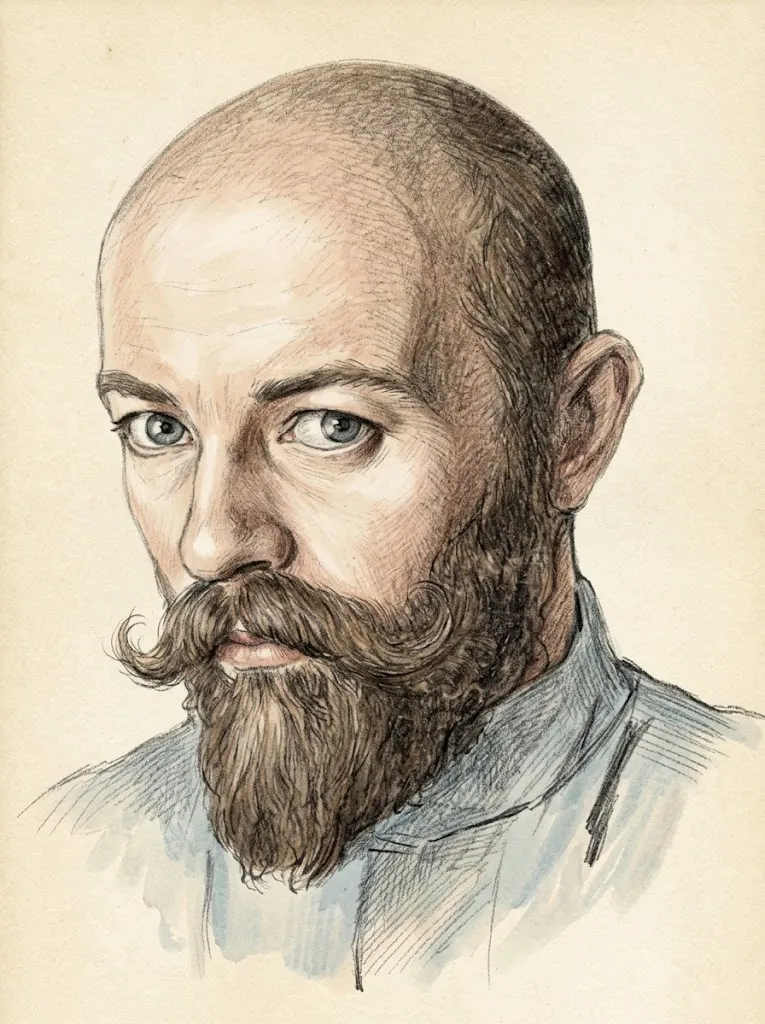
Vasyl Sedliar
Boichukist painter, Kobzar illustrator
His Kobzar was pulled from libraries and torn up in police searches. Vasyl Sedliar, a student of Mykhailo Boichuk, illustrated the whole 1931 Kobzar, ran the Mezhyhiria ceramics school and trained young artists. He was shot in 1937.
Key accomplishments
- 75 illustrations for Taras Shevchenko’s Kobzar (Kharkiv, 1931)
- Studied in Mykhailo Boichuk’s workshop at the Ukrainian Academy of Arts; one of the leading Boichukists
- Director of the Mezhyhiria Ceramics School (1923–1930); taught at the Kyiv Art Institute (1930–1936)
- Murals for the Lutsk Barracks in Kyiv (1919); the fresco Industrialization at the Chervonozavodskyi Theatre in Kharkiv
- Paintings Execution (1927) and Portrait of Oksana Pavlenko (1927); the drawing series Europe; the essay AKhRR and ARMU (1926)
The book they burned
What could frighten the authorities in a book of poems? The pictures. In 1931, for the 70th anniversary of the death of Taras Shevchenko, a large Kobzar of some five hundred pages came out in Kharkiv, illustrated from cover to cover by Vasyl Sedliar, with 75 of his pictures. Soon copies were being removed from libraries and bookshops. In 1933 the Kobzar was printed again, in a run of 10,000. Accounts differ on what happened next: some say the whole run was destroyed at the printing house, others that it came out and was hunted down too. In 2009 the book was reissued from two surviving copies, one from 1931 and one from 1933.
Boichuk’s student
Vasyl Sedliar was born in 1899 on the Khrystivka farmstead near the village of Zhorzhivka in the Poltava region. He studied at the Kyiv Art School, and in 1919 he entered the Ukrainian Academy of Arts and joined the workshop of Mykhailo Boichuk. Boichuk taught his students to look for new art in icons and folk painting, and Sedliar became one of the most prominent of them. That same year the Boichukists painted murals in the Lutsk Barracks in Kyiv; they were destroyed in 1922.
A teacher of ceramicists
From 1923 to 1930 Sedliar ran the ceramics school at Mezhyhiria, just outside Kyiv. Oksana Pavlenko and Ivan Padalka worked there with him. In 1926 he wrote the essay AKhRR and ARMU, arguing against the influence of russian realist painting on Ukrainian art. In 1926–1927 he toured Europe’s museums with Boichuk, Germany and France among them, and brought back a series of drawings called Europe, which Party critics attacked. From 1930 he trained ceramicists at the Kyiv Art Institute, and in Kharkiv he worked on the fresco Industrialization for the Chervonozavodskyi Theatre.
1936–1937
On 26 November 1936 Sedliar was arrested in Kharkiv and, on the strength of fabricated documents, declared an “enemy of the people.” On 13 July 1937 he was shot in Kyiv, on the same day as Mykhailo Boichuk and Ivan Padalka. Most of his work was destroyed. He was rehabilitated in 1958. His first solo exhibition did not open until 2009, at the National Art Museum of Ukraine: two small rooms, some twenty works, and only four paintings that had survived.
Why it matters today
Vasyl Sedliar gave the Kobzar a new look, in the language of icons, frescoes and folk painting that he had learned from Boichuk. He spoke out openly against Ukrainian art copying russian realist painting. As a director and teacher he trained ceramicists and artists, so the Boichukist school lived on in his students too. They tried to erase his Kobzar along with him, but the book came back to its readers. Anyone who illustrates, paints or publishes books today can carry on what he started: showing their own classics in their own visual language.