1909–1997
Mariia Prymachenko
Master of folk painting
Picasso himself is said to have bowed before her “artistic miracle”. Nobody can quite prove it, but the fantastic beasts of Mariia Prymachenko, from the Polissia village of Bolotnia, have become a symbol of Ukraine’s resilience.
Key accomplishments
- More than 60 years of work and over 800 pieces; the largest collection is at the National Museum of Ukrainian Folk Decorative Art
- Shown at the 1937 World’s Fair in Paris and at more than 120 exhibitions in Ukraine and abroad
- Shevchenko Republican Prize (1966); People’s Artist of the Ukrainian SSR (1988)
- UNESCO declared 2009 the Year of Mariia Prymachenko
Did Picasso really bow before her?
In 1937 Mariia Prymachenko’s work was shown at the World’s Fair in Paris. Ever since, people have quoted Pablo Picasso as saying, on seeing it, that he bowed before “the artistic miracle of this brilliant Ukrainian woman”. It’s a lovely story, but no one cites a primary source for the line.
What we do know: a year before Paris, her work won first prize at an exhibition of folk art in Kyiv, Moscow and Leningrad. Not bad for a self-taught artist.
The girl from Bolotnia
Mariia Prymachenko was born in 1909 in the village of Bolotnia in the Kyiv region, near Ivankiv, and lived there almost all her life. As a child she had polio and was left disabled. She taught herself to paint. In 1935–1938 she worked in Kyiv, at experimental workshops in the Kyiv Pechersk Lavra.
Beasts that don’t exist
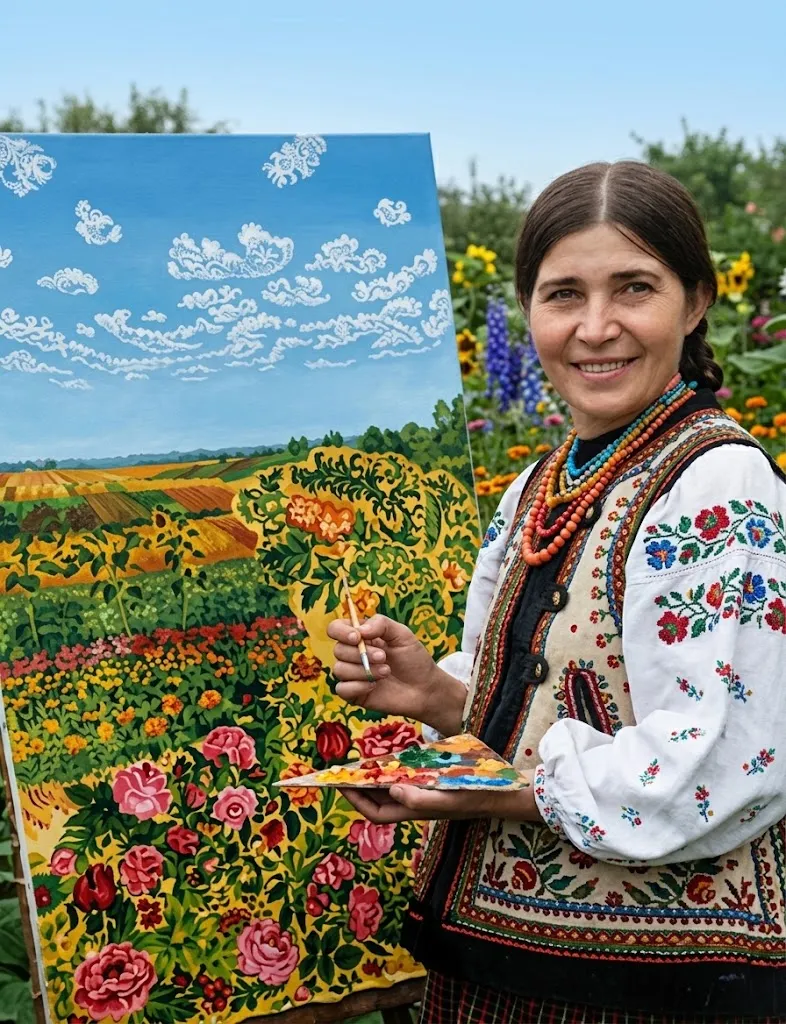
She painted flowers in unusual colors, birds as signs of goodness and peace, and fantastic “beasts” that became her trademark. She began with watercolor, moved on to gouache, and from the mid-1960s swapped white backgrounds for colored ones. She illustrated children’s books, made a series about the Chornobyl disaster in 1986, and created more than 800 works in all. In 1966 she won the Shevchenko Republican Prize, and for her 100th anniversary UNESCO declared 2009 the Year of Mariia Prymachenko.
Why it matters today
In late February 2022, in the first days of the full-scale invasion, Russian shelling set the local history museum in Ivankiv on fire. The museum’s guard and his wife broke the windows and carried Prymachenko’s paintings out under fire, and the paintings survived. Since then her “beasts” and doves, on stamps and murals, have become a symbol of Ukraine’s resilience.