The Bykivnia tragedy
Bykivnia forest, Kyiv
For four years NKVD trucks drove almost every night to a forest outside Kyiv with the bodies of people shot in the city's prisons. Bykivnia is Ukraine's largest burial site of victims of Stalin's terror: tens of thousands of people of over 30 nationalities. For 50 years the regime blamed the Nazis.
Timeline
- 20 March 1937 The Kyiv city council hands a plot of the Bykivnia forest over “for the special needs of the NKVD”
- 5 August 1937 The mass operation under NKVD Order No. 00447 begins, and with it the first burials at Bykivnia
- 19 May 1938 563 people are shot in Kyiv in a single night
- September 1941 The burials stop as the Soviet authorities retreat from Kyiv
- 21 September 1941 The German occupiers dig up some of the graves and use them for propaganda
- 1944, 1971, 1987 Three Soviet commissions blame the graves on the Nazis
- 1962 Les Taniuk, Alla Horska and Vasyl Symonenko see the graves and appeal to the authorities
- 15 July 1988 The first memorial rally for the victims in the Bykivnia forest
- 1989 A government commission admits that victims of the NKVD lie here
- 30 April 1994 The first Bykivnia memorial complex opens
- 22 May 2001 The state reserve “Bykivnia Graves” is founded; in 2006 it becomes a national one
- 21 September 2012 The International Memorial to the Victims of Totalitarianism and the Polish War Cemetery open
A quiet pine forest grows beside the Chernihiv highway on the north-eastern edge of Kyiv. Local people were once told that behind its high fence stood an artillery depot. In fact, from 1937 to 1941, trucks of the NKVD, the Soviet secret police, brought here almost every night the bodies of people shot in Kyiv’s prisons. Bykivnia is the largest burial site of victims of Stalin’s repressions in Ukraine. How many people lie here is still not known for certain: historians estimate from 20,000 to 100,000 or more.
Why it happened
In the summer of 1937 the Great Terror began across the USSR. On 30 July the People’s Commissar of Internal Affairs signed NKVD Order No. 00447, and on 5 August a mass operation against “anti-Soviet elements” began. Moscow handed every region “limits”, quotas for how many people to shoot and how many to send to the Gulag camps. Ukraine was first given 26,150 executions, and in January 1938 the limit was raised to 83,122. The heads of the Ukrainian NKVD themselves wrote to Moscow asking for more.
Sentences were passed not by courts but by “troikas”: the head of the oblast NKVD, the prosecutor and the party secretary. Anyone could be caught: veterans of the Ukrainian Revolution, priests, peasants, workers, scholars. Separate “national” operations targeted Poles, Germans, Greeks and others for their origins. Between August 1937 and December 1938 alone, 19,727 people were shot in Kyiv.
What happened
On 20 March 1937, even before the mass operation began, the Kyiv city council handed a plot of the Bykivnia forest over “for the special needs of the NKVD”. Officially it covered 4.2 hectares, in fact about 5.3. It was fenced off, with a watchtower and an armed guard around the clock.
People were shot in Kyiv: in the Lukianivka prison, in the NKVD’s internal prison in the former Institute for Noble Maidens (later the Zhovtnevyi Palace), and in NKVD buildings on today’s Lypska and Volodymyrska streets. The worst night was 19 May 1938, when 563 people were shot on decisions of the Kyiv troika. Families were told their relative had been sent away for 10 years “without the right of correspondence”, and in 1955 the KGB ordered that they be given a false date and cause of death.
Researchers believe that buried at Bykivnia are the painters Mykhailo Boichuk, Sofiia Nalepynska-Boichuk, Ivan Padalka and Vasyl Sedliar, the poets Mykhail Semenko and Maik Yohansen, Metropolitan Vasyl Lypkivskyi of the Ukrainian Autocephalous Orthodox Church, the director of the Franko Theatre Kyrylo Hetman, the academician Fedir Kozubovskyi, and thousands of people whose names only their families know. The burials went on until September 1941, when the Soviet authorities fled Kyiv. As late as 10 July 1941 the Greek Catholic priest Andrii Bandera, father of Stepan Bandera, was shot here.
How the truth was hidden
German troops took Kyiv on 19 September 1941. As early as 21 September the occupiers, together with people from Bykivnia village, dug up some of the graves, and from 29 September newspapers in Germany, Austria and the Netherlands, and later Ukrainian papers in the occupied lands, wrote about the find. The Nazis wanted it to show the criminal nature of the Bolshevik regime and to win over the local population: even before the invasion of the USSR, the German command had told its propaganda to claim that Germany was at war not with the peoples of the Soviet Union, but only with their “Jewish-Bolshevik” government. In 1943 a German leaflet, “New Vinnytsia”, pointed to “a much wider burial field near Kyiv” as proof that Bolshevism had not changed.
Yet the Nazis wrote about Bykivnia with restraint, as ordinary news. Probably this was partly because at the end of September 1941 they themselves were shooting Kyiv’s Jews at Babyn Yar.
Back in Kyiv, in 1944 the Soviet authorities announced that the forest held victims of the “German-fascist invaders”, and in 1945 they sentenced Semen Dembovskyi, the Bykivnia villager who had shown the Germans the graves, to 10 years in the camps. Government commissions in 1971 and 1987 repeated the story that the Nazis were to blame. In 1988 a monument was even put up here, saying that 6,329 Soviet soldiers, partisans and civilians killed by the fascists were buried in the forest.
How the forest gave up its secret
In the autumn of 1962 the director Les Taniuk, the artist Alla Horska and the poet Vasyl Symonenko of the Kyiv Club of Creative Youth saw human bones lying on the ground in the Bykivnia forest. With other members of the club, they demanded that the Kyiv city council make the mass graves public and turn them into places of remembrance. The club was soon shut down, and on 8 January 1971 Taniuk wrote again, to the Soviet leaders and to Petro Shelest, first secretary of the Communist Party of Ukraine.
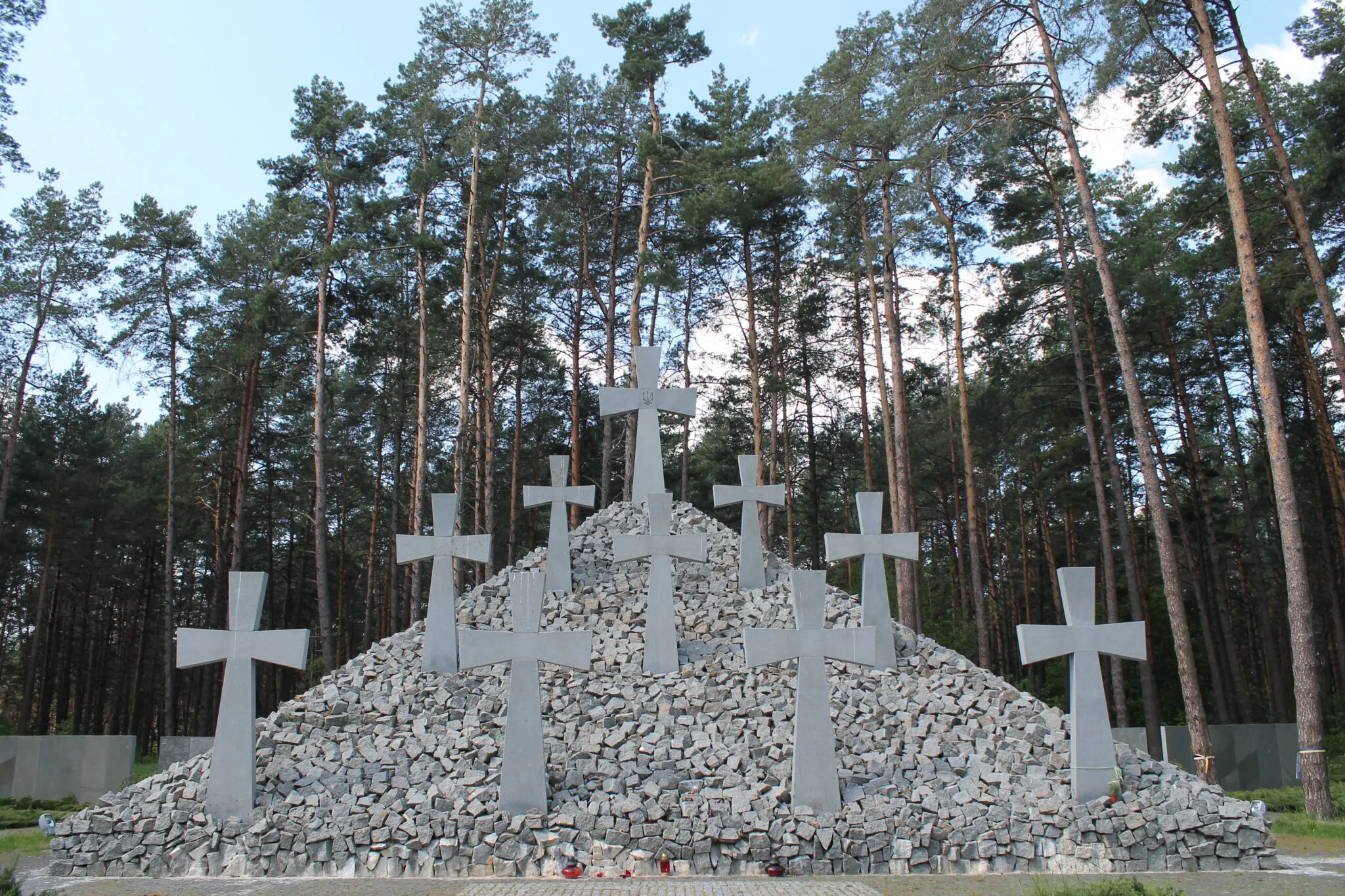
The official inscription on the 1988 monument said that the people here had been “tortured to death by the fascist occupiers in 1941–1943”. But people from the nearby villages remembered otherwise: from the summer of 1937, long before the war, they had watched columns of five or six trucks drive at night into the zone behind the “green fence”, carrying something under tarpaulins. They were told it was shells. On 15 July 1988, just two months after the monument went up, Kyivans gathered for the first time in large numbers to honour the victims of Stalin’s repressions, at the call of the Ukrainian Culturological Club. The Bykivnia memorial days have been held ever since. Eyewitness accounts appeared in the press, and in December the prosecutor’s office opened a criminal case, and in 1989 a government commission, drawing on more than two hundred witnesses, admitted it: the people buried here had been shot by the NKVD. Even then, it put the number buried at only 6,783, many times fewer than researchers believe. The false inscription was removed, and on 10 May 1990 a large oak cross was put up in the forest. On 30 April 1994 the first Bykivnia memorial complex opened, and in 1995 the first memorial crosses and a sculpture followed.
The state reserve “Bykivnia Graves”
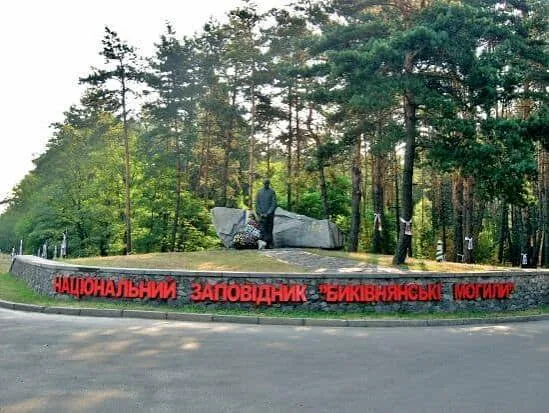
In 2001 the state reserve “Bykivnia Graves” was founded here, Pope John Paul II visited on 24 June that year, and in 2006 the reserve became a national one. In 2001–2012 Ukrainian and Polish archaeologists studied the graves. To find every grave, Professor Andrzej Kola’s Polish expedition made 5,000 test borings in 10 months of fieldwork and marked 217 graves. The objects they found often told whose they had been: a comb with prisoners’ surnames scratched on it, a toothbrush marked “J. Łobaz”, the badge of the Polish policeman Mikołaj Cholewa. Each named find was checked against the archival execution records. On 21 September 2012 the International Memorial to the Victims of Totalitarianism of 1937–1941 opened, and next to it the Polish War Cemetery, for Polish citizens shot by the NKVD in 1940. Every year on the third Sunday of May, the Day of Remembrance of Victims of Political Repression, the dead are honoured at Bykivnia.
How many lie here
There is no full list of victims: the execution records are scattered across different case files, and some are still out of reach. So estimates vary widely, from 20,000 to 100,000 people or more. In 2009 SBU archivists established the names of 14,191 people, and more than 18,500 names are now known. Those buried here belonged to over 30 nationalities. Polish citizens from the “Ukrainian Katyn List” lie here too: by different counts, from 2,000 to more than 3,000 people.
Why it matters today
The people of Bykivnia were killed not for anything they did, but for their origins, their faith, their words, or simply to fill a quota. For half a century the regime tried to wipe them from memory and pin the blame on others, but the truth was found and given back by those who were not afraid to look: the young artists of the 1960s, the Kyivans at the 1988 rally, and the researchers who are still piecing the names together. Bykivnia shows how an empire destroys people and then lies about it, and that memory, too, has to be defended. Families hang signs on the pines with the names of relatives they believe lie here: every name given back is a person the regime failed to erase.