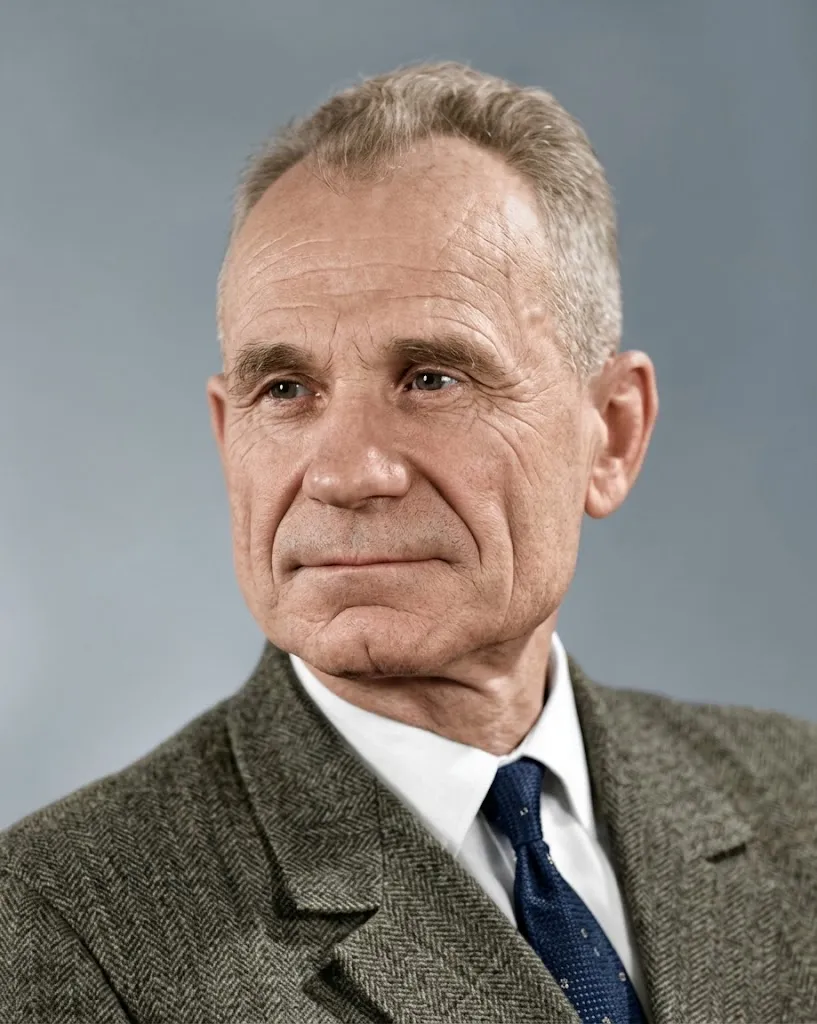
George Gamow
Physicist and cosmology pioneer
A particle cannot muster the energy to leave an atomic nucleus, yet it escapes. Odesa-born George Gamow explained how, then explored the hot early universe and the genetic code.
Key accomplishments
- Quantum explanation of alpha decay (1928)
- Research into the hot early universe and the formation of elements
- Early proposals about the genetic code
- Mr Tompkins popular-science books; Kalinga Prize (1956)
Through a forbidden barrier
A particle lacks the energy to escape an atomic nucleus. Yet it gets out. How? In 1928, at the age of 24, George Gamow explained alpha decay using quantum mechanics: a particle can pass through an energy barrier that classical physics says should hold it inside. The process is called quantum tunnelling. Ronald Gurney and Edward Condon reached the explanation independently.
Gamow went on to study how elements formed in the early universe and even tackled the genetic code. His journey began in Odesa.
From Odesa to European laboratories
The future cosmologist was born on the Black Sea coast on 4 March 1904. He studied in Odesa, attending its university in 1922–1923, before continuing his education in Leningrad. In the late 1920s he worked in Göttingen, Copenhagen and Cambridge, among scientists who were changing the understanding of the atom.
His connection to Ukraine is specific: Odesa was his birthplace and the starting point of his education. His major discoveries grew out of an international scientific community, and he spent most of his later career in the United States, where he became known as George Gamow.
A boat and the freedom to travel
His route into international science nearly closed. After returning to the Soviet Union, Gamow was denied permission to travel abroad. In 1932 he and his wife tried to reach Turkey from Crimea by boat across the Black Sea. The attempt failed.
Another route opened the following year: he was allowed to attend a physics congress in Brussels and did not return to the USSR. He moved to the United States in 1934, working at George Washington University and, from 1956, at the University of Colorado.
The universe as a physics problem
Where did the chemical elements come from? Gamow and his colleagues sought answers in a hot, dense early universe. Their research became an important contribution to the development of Big Bang theory. It offered a way to investigate cosmic history through physical processes, rather than simply describe stars and galaxies.
After the discovery of DNA’s structure, he posed another question: how could its four kinds of building blocks encode proteins made from twenty amino acids? His proposed mechanism proved incorrect, but framing the problem helped stimulate research into the genetic code. A bold hypothesis still has to be tested - and can be useful even when it has to be rejected.
Physics without a laboratory
Gamow invented Mr Tompkins for people who did not read scientific papers. His character’s adventures explained relativity and quantum physics. In 1956 Gamow received UNESCO’s Kalinga Prize for making science accessible. He died in Boulder on 19 August 1968.
Why it matters today
Gamow helped connect the atomic nucleus to the history of the universe and brought difficult physics within reach of ordinary readers. His journey from Odesa shows how people born in Ukraine contributed to international science, without assigning all their discoveries to a single country. Asking an unexpected question and testing the answer remains a useful habit for anyone who hopes to discover something.