1908–1984
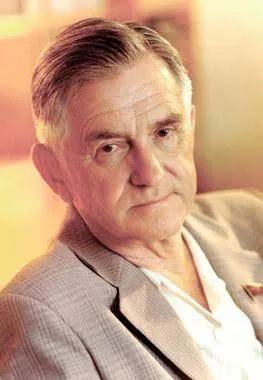
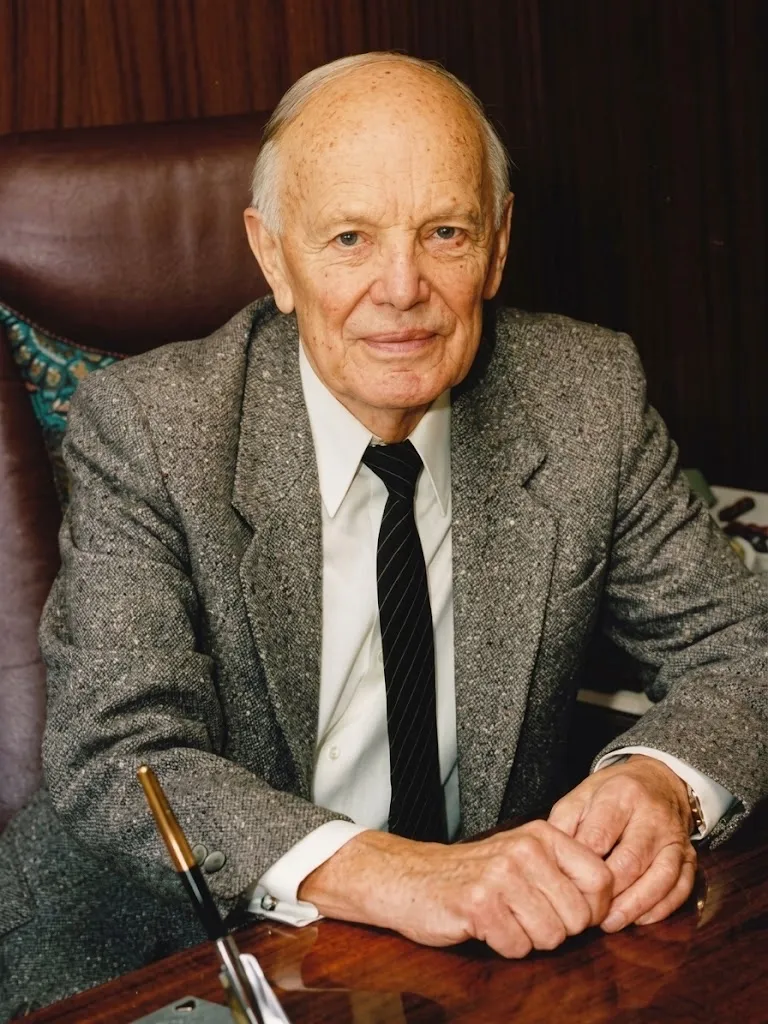
Arkhyp Liulka
Jet engine designer
“In Moscow they think I’m a Ukrainian nationalist, and at home, a Muscovite,” said Arkhyp Liulka. A boy from the Kyiv region, he began designing a jet engine in Kharkiv and became one of the first Soviet jet engine designers. From 1939 he worked in russia, but kept his Ukrainian to the end.
Key accomplishments
- Design of the RD-1 turbojet engine (Kharkiv, 1937–1939)
- Patent for a bypass (two-circuit) turbojet layout (1941)
- Methods for calculating how turbojets perform at different altitudes and speeds
- The AL series of engines for supersonic aircraft
- The light TS-31M engine for Oleh Antonov’s An-13 motor glider
A plane without a propeller
How do you make a plane fly faster than a propeller allows? In 1937, in Kharkiv, a young lecturer at the aviation institute named Arkhyp Liulka was working on exactly that. His group designed a turbojet engine, the RD-1, meant to push a plane to about 900 kilometres an hour. The institute’s academic council rated the design poorly, and the Kharkiv plant stopped the work. Liulka did not give up the idea.
Mykhailo Kravchuk’s pupil
Arkhyp Liulka was born on 23 March 1908 in the village of Savarka in the Kyiv region, into a large peasant family. He lost his parents early, herded cattle and wrote poems. When he was 11, a teacher noticed how gifted he was: the mathematician Mykhailo Kravchuk. Kravchuk set him hard problems, urged him to apply to the Kyiv Polytechnic Institute, and in Kyiv let him live in his own home for the first six months. Liulka graduated in 1931 and went to work in Kharkiv.
From Kharkiv to Moscow
In 1939 Liulka and his design were moved to Leningrad, to the Kirov plant, where a design bureau was set up for him. In April 1941 he patented a layout for a bypass turbojet, in which part of the air flows around the combustion chamber. The war cut the work short, and the drawings had to be buried at the plant. From 1943 Liulka worked in Moscow, and in 1946 he became head of his own design bureau.
The AL engines
Under Liulka’s lead, his bureau built the AL series of engines. They powered aircraft from the Sukhoi, Ilyushin, Beriev and Tupolev design bureaus, supersonic ones among them. He worked out the theory and methods for calculating how a turbojet performs at different altitudes and speeds, and he designed the first Soviet bypass turbojet. His lightest engine, the TS-31M, weighed just 23 kilograms: it powered the An-13 motor glider of Oleh Antonov.
“My soul is here”
Liulka spent more than half his life in Moscow, but he did not forget home. He read Ukrainian magazines, kept more than a thousand books on Ukrainian studies, and wrote to people from home only in Ukrainian. Portraits of Taras Shevchenko and of his teacher Mykhailo Kravchuk hung in his study. When officials from Kyiv spoke russian at a gathering in Savarka, he answered in Ukrainian: “My soul is here, in Ukraine, in Savarka.” Arkhyp Liulka died in Moscow on 1 June 1984.
Why it matters today
Arkhyp Liulka showed that a village boy, noticed in time by a good teacher, could become one of the first designers of jet engines. He took his first steps on that path in Ukraine: at the institute in Kyiv and in a laboratory in Kharkiv. His talent served the Soviet state far from home, yet he never gave up his language or his Savarka. His story is a reminder of how much Ukraine gave to someone else’s empire, and of why it matters that talents like his now build a country of their own.