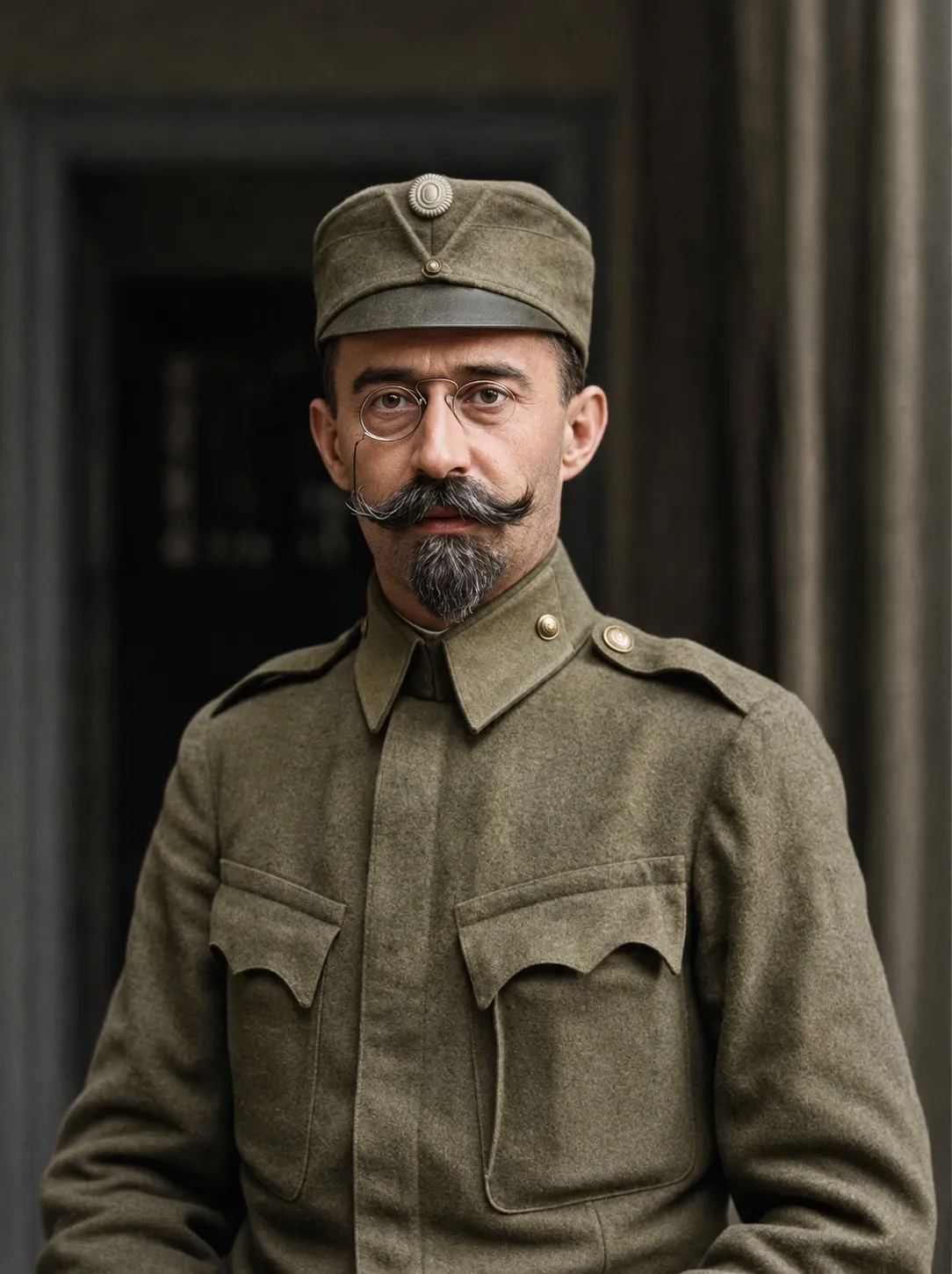
The Unification Act
Sofiiska Square, Kyiv
On 22 January 1919, on Sofiiska Square in Kyiv, the Ukrainian People's Republic and the West Ukrainian People's Republic were proclaimed one state. The union was never fully carried out, but since that day Ukraine has been seen as one, and 22 January is marked as the Day of Unity.
Timeline
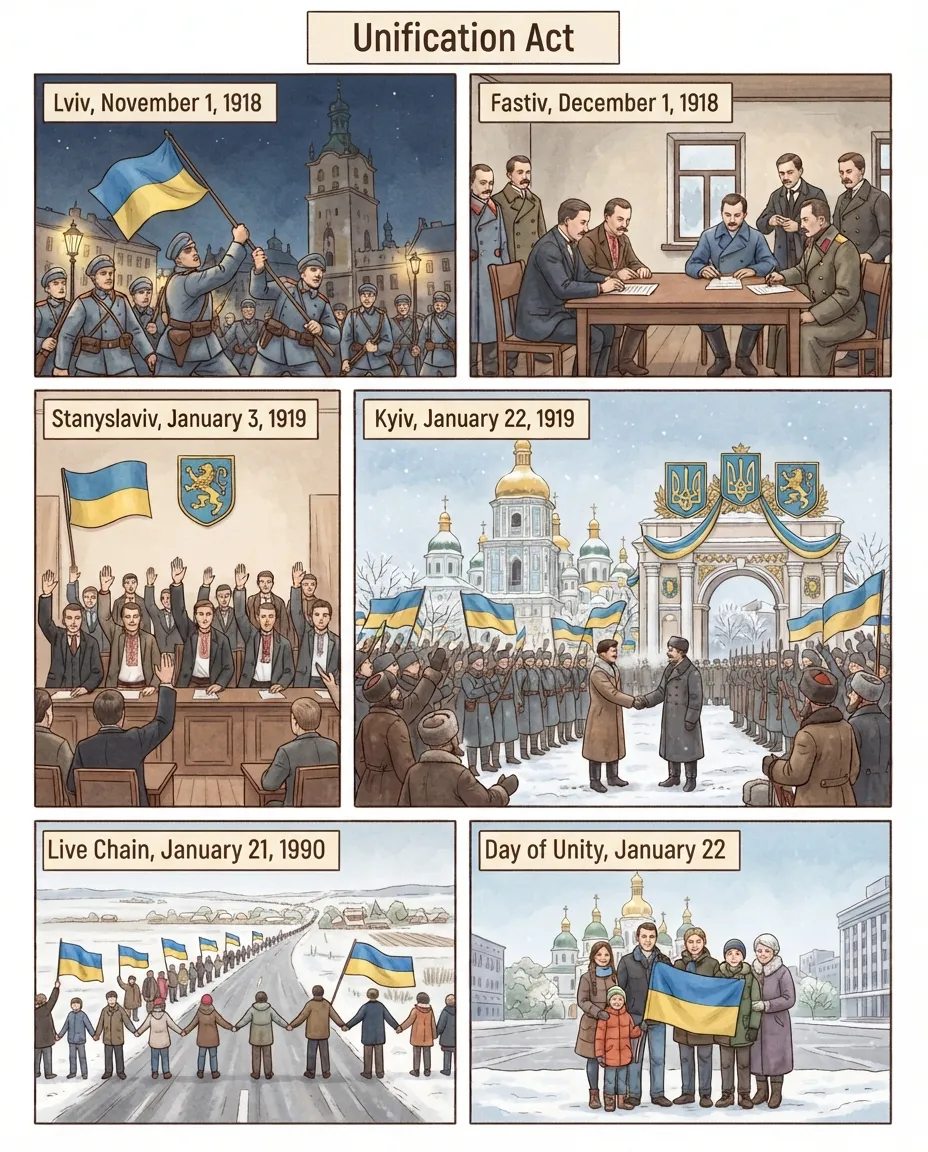
- 1 November 1918 Ukrainians take power in Lviv; the West Ukrainian People's Republic is born
- 1 December 1918 In Fastiv the UNR Directorate and a ZUNR delegation sign a preliminary treaty on union
- 3 January 1919 The Ukrainian National Rada in Stanyslaviv votes for union with the UNR
- 22 January 1919 The Unification Act is solemnly proclaimed on Sofiiska Square in Kyiv
- 23 January 1919 The Labour Congress unanimously approves the union
- 2 December 1919 The UNR mission in Warsaw agrees to cede Eastern Galicia to Poland
- 20 December 1919 The ZUNR government in Vienna annuls the Unification Act on its own
- 21 January 1990 A human chain from Kyiv to Lviv marks the anniversary of the union
- 1999 The Day of Unity, 22 January, becomes a state holiday
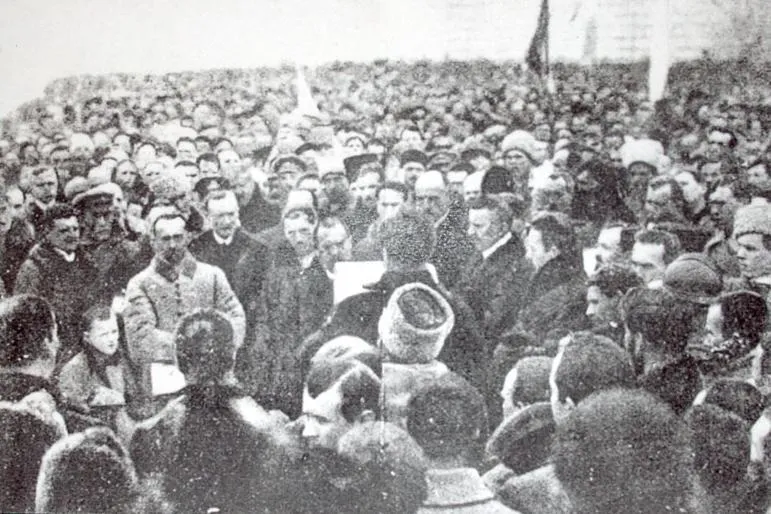
At noon on 22 January 1919, on a snow-covered Sofiiska Square in Kyiv, thousands of people heard the words: “From this day on, the parts of one Ukraine, torn apart for centuries, are joined into one.” Ukrainians from the east and the west, long divided by the borders of empires, proclaimed a single state. The day became known as the Unification, and later as the Day of Unity.
Two republics
After the First World War the two empires that had divided the Ukrainian lands fell apart. In the east, in the former Russian Empire, the Ukrainian People’s Republic (UNR) had existed since 1917. In the west, once ruled by Austria-Hungary, Ukrainian soldiers led by Dmytro Vitovskyi took power in Lviv on the night of 1 November 1918. That was the birth of the West Ukrainian People’s Republic (ZUNR), meant to include Eastern Galicia, Northern Bukovyna and Transcarpathia.
Both states were in danger. The ZUNR was at war with Poland, which also claimed Galicia, and its government had to move from Lviv to Ternopil and then to Stanyslaviv. In the UNR, in November 1918, the Directorate led by Volodymyr Vynnychenko rose against the Hetman and soon had to defend itself against the Bolsheviks. In the east and the west alike, people understood that they stood a better chance together.
From Fastiv to Stanyslaviv
The ZUNR wanted the union to rest on law. Its envoys, the lawyers Lonhyn Tsehelskyi and Dmytro Levytskyi, brought a draft treaty to Fastiv, where the Directorate was based at the time. On 1 December 1918 a preliminary treaty was signed there: the ZUNR declared its “firm intention to merge as soon as possible into one great state” with the UNR. Among those who signed for the Directorate were Vynnychenko and Symon Petliura.
On 3 January 1919 in Stanyslaviv (today Ivano-Frankivsk), the Ukrainian National Rada, the ZUNR’s parliament, led by Yevhen Petrushevych, voted unanimously for union with the UNR. A 65-member delegation headed by Lev Bachynskyi set off for Kyiv, with envoys from Galicia, Bukovyna and Transcarpathia. Among them was the writer Vasyl Stefanyk, the Rada’s vice-president.
A celebration on Sofiiska Square
The union was timed for the first anniversary of the Fourth Universal, by which the UNR had declared independence on 22 January 1918. Ivan Ohiienko wrote the plan for the celebration, and the actor Mykola Sadovskyi ran the ceremony on the square. The day was declared a holiday, Kyiv was decorated with blue and yellow flags, and a triumphal arch with the coats of arms of Ukraine and Galicia stood at the entrance to the square. It was bitterly cold.
At twelve o’clock the western Ukrainian delegation lined up facing the Directorate, the government and the army staff. Lonhyn Tsehelskyi read out the resolution of the Ukrainian National Rada, and then the Directorate’s Universal on the union was proclaimed. Vynnychenko and Bachynskyi shook hands, and a cry of “Glory!” rolled across the square. A prayer service for a united Ukraine followed, then a military parade. Petliura and Vitovskyi were on the square, and the UNR government was then headed by Volodymyr Chekhivskyi.
The next day, 23 January, the Labour Congress, the UNR’s parliament at the time, unanimously approved the Universal. Petrushevych joined the Directorate.
Why the union failed
The ZUNR became the Western Province of the UNR but kept its own Rada, government and army: the union was to be finally sealed by a Constituent Assembly of all Ukraine. The two parts managed to introduce a common currency, coordinate command at the front and send a joint delegation to the peace conference in Paris. The war kept them from finishing the job. In early February 1919 the Directorate, pressed by the Bolsheviks, left Kyiv, and by the summer Poland had taken almost all of Galicia.
The governments of the UNR and the ZUNR drifted further apart: for the Dnipro lands the main enemies were the Bolsheviks and the Whites, for the Galicians it was Poland. Looking for an ally against Bolshevik russia, on 2 December 1919 the UNR mission in Warsaw agreed to give Eastern Galicia and Western Volhynia to Poland. In response, on 20 December 1919 Petrushevych called a meeting of the ZUNR government in Vienna, which annulled the Unification Act on its own. The union had lasted less than a year.
The human chain
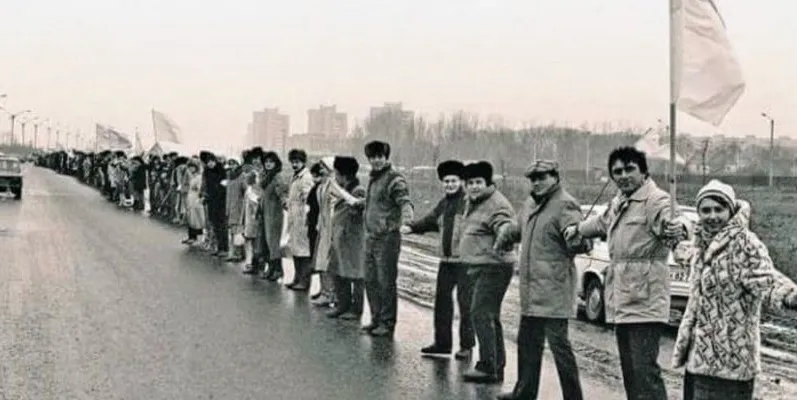
The Soviet regime kept silent about the union for decades, but the memory of it survived. On 21 January 1990, on the eve of the anniversary of the Unification Act, people joined hands and formed an unbroken human chain from Kyiv to Lviv. The idea came from Mykhailo Horyn, one of the founders of the People’s Movement of Ukraine (Rukh). No one knows exactly how many took part: estimates range from half a million to three million people. It was one of the largest mass actions in Central and Eastern Europe. Hand in hand, Ukrainians showed that east and west were one, and that they were no longer afraid of the communist regime.
Why it matters today
The union of 1919 did not last long, but it showed that Ukrainians from the east and the west wanted to live in one state, and that they chose it themselves, of their own free will. From that day on, Ukraine was imagined as one country. Since 1999, 22 January has been a state holiday, the Day of Unity. Anyone who defends Ukraine’s wholeness today carries on what was proclaimed on Sofiiska Square.