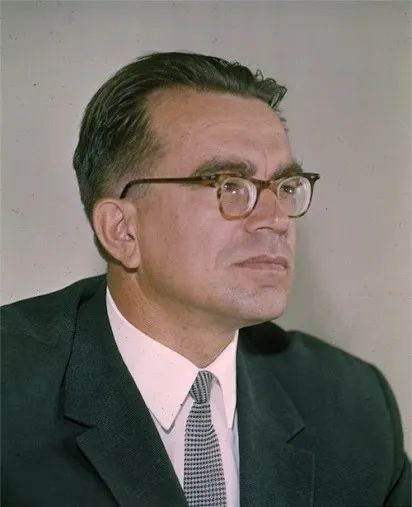
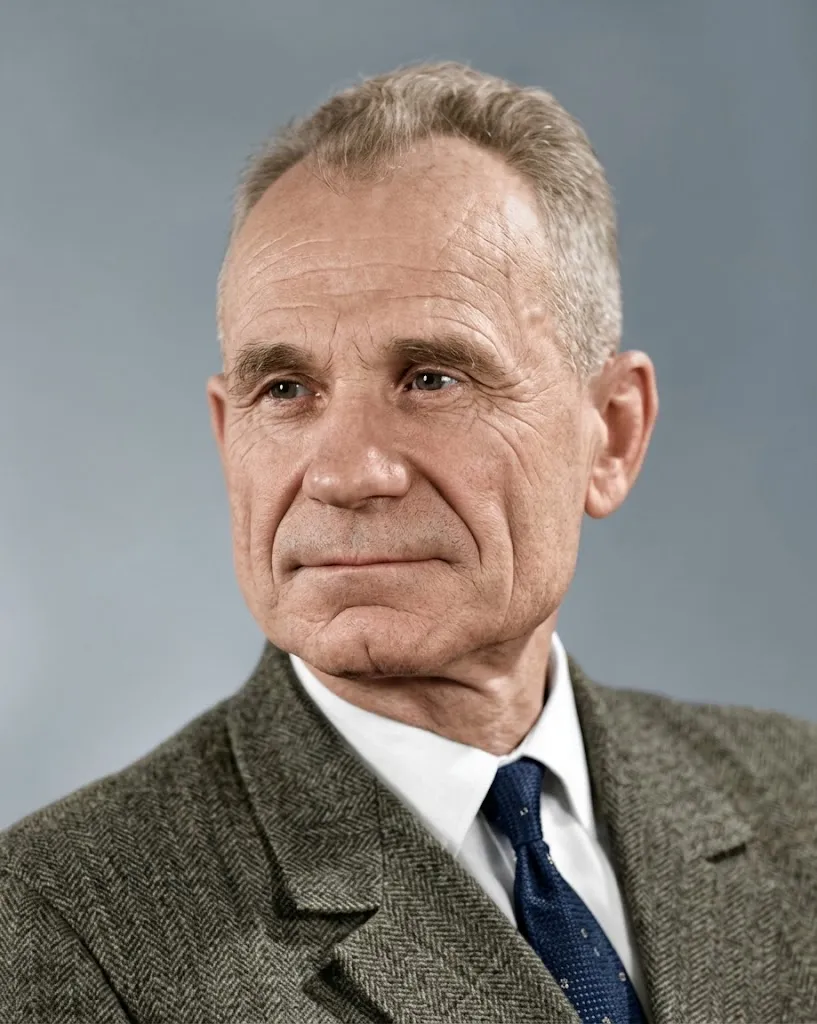
Borys Paton
Electric welding scientist
Did you know that metal was first welded aboard a spacecraft in 1969, using a unit built by Kyiv’s Institute of Electric Welding? The institute’s director, Borys Paton, headed the Academy of Sciences of Ukraine for 58 years.
Key accomplishments
- Created electroslag welding together with H. Voloshkevych (1949)
- The world’s first welding experiments in space, aboard the Soyuz-6 spacecraft (1969)
- Director of the Institute of Electric Welding (1953–2020) and president of the Academy of Sciences of Ukraine (1962–2020)
- A method of welding living soft human tissue for surgery
Welding that helped win a war
From three tanks a day to 35: that, in Borys Paton’s words, was how output grew at the plant where his institute’s scientists worked. He was born in 1918 in Kyiv into the family of Yevhen Paton, the scientist after whom the Institute of Electric Welding was later named. In 1941 he graduated from the Kyiv Industrial Institute (now the Kyiv Polytechnic Institute): the war began on the very day he defended his diploma, and he made his way home during a bombing raid. He then became an engineer at the Krasnoye Sormovo plant in the city of Gorky. From 1942 Paton worked at the Institute of Electric Welding, which had been evacuated to Nizhny Tagil, and helped introduce automatic welding of tank armor.
How do you weld metal in space?
Electroslag welding, which Paton created in 1949 with H. Voloshkevych, is a way of joining very thick metal parts for powerful power plants and heavy equipment. In 1953 Paton became head of the Institute of Electric Welding and led it until 2020. In 1981, on the basis of the institute’s documents, UNESCO marked the centenary of arc welding, invented by Mykola Benardos. The institute took on space as well: in 1969 the world’s first welding experiments were carried out aboard the Soyuz-6 spacecraft with its Vulkan unit, and in 1984 welding was done in open space.
58 years at the head of the Academy
Paton was exactly as old as the Academy: he was born on 27 November 1918, the very day the founding meeting of the Ukrainian Academy of Sciences elected Volodymyr Vernadskyi its first president. Paton was elected president of the Academy of Sciences of the Ukrainian SSR (from 1994 the National Academy of Sciences of Ukraine) in 1962. He headed it for 58 years, until his death in 2020. In the 1970s he was offered the presidency of the USSR Academy of Sciences in Moscow, to replace the ailing Mstislav Keldysh. Even when told it was Brezhnev’s “personal initiative”, he refused, believing his place was in Kyiv. Before the disaster, the Academy under his direction assessed the possible harm to the environment, society and the economy of building a nuclear plant near Chornobyl and reported it to the Soviet leadership. After the 1986 disaster its institutes worked on the clean-up from the very first days. In independent Ukraine Paton was the first person ever made a Hero of Ukraine (1998). After 1991, despite sharp cuts in funding, he is considered to have preserved the Academy’s main scientific schools.
Why it matters today
Borys Paton showed that science made in Kyiv can work in a factory, in space and in an operating room. Under his direction a Kyiv institute carried out the world’s first welding experiments in space, and the way of welding living tissue developed there now helps surgeons. After 1991, despite sharp cuts in funding, he is considered to have kept the Academy’s main scientific schools alive for independent Ukraine. He turned down Moscow for Kyiv, and anyone who dreams of a life in science can see in him proof that discoveries from Ukrainian labs are needed by the whole world.