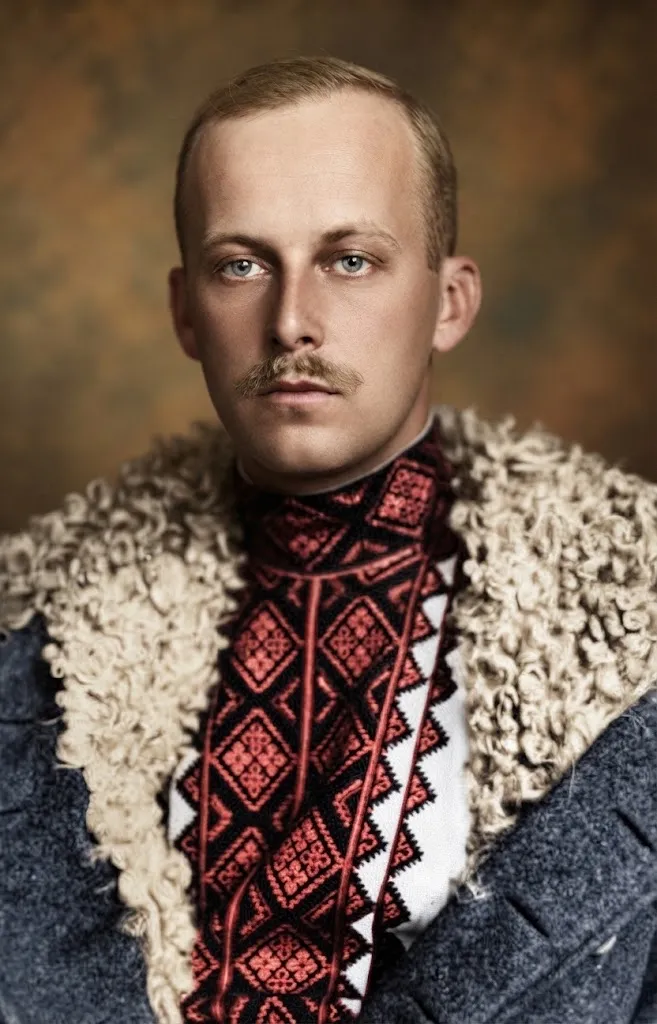
1890–1980
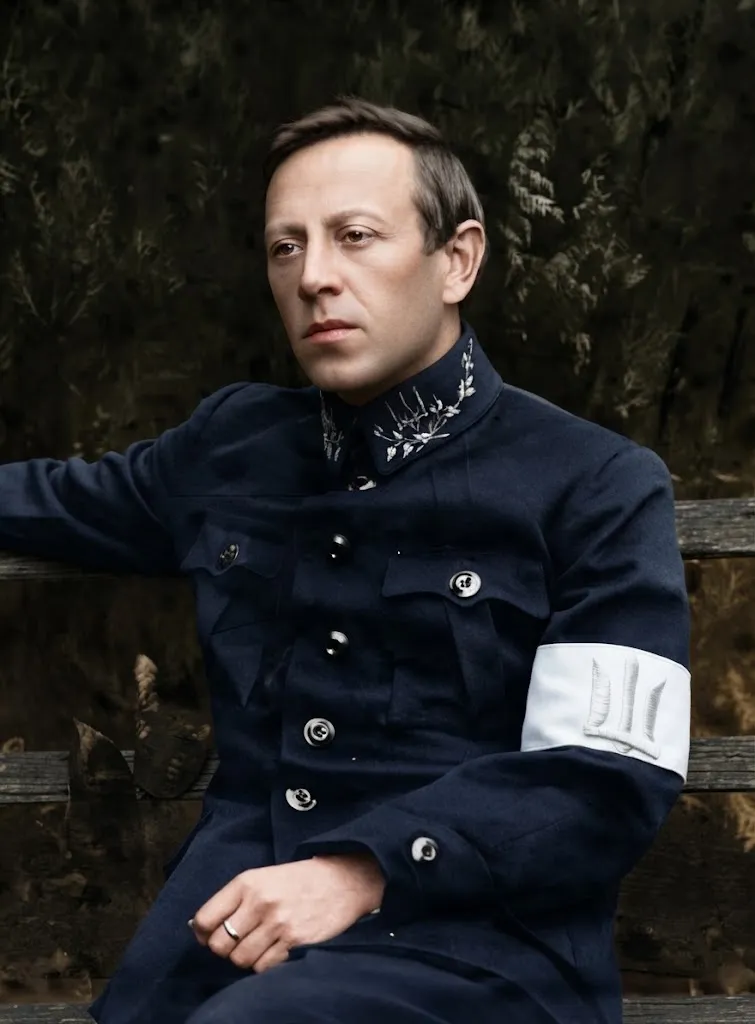
Averkii Honcharenko
Ukrainian commander at Kruty
About 500 young volunteers against a force eight times larger. At Kruty in 1918 they were led by 27-year-old Captain Averkii Honcharenko. The battle held up the Bolshevik advance on Kyiv; Honcharenko lived another 62 years and died in exile in the United States.
Key accomplishments
- Ukrainized the Kyiv ensign school, which became the First Ukrainian Bohdan Khmelnytsky Cadet School (1917)
- Commanded the Ukrainian units at the Battle of Kruty on 29 January 1918
- Head of the chancellery of Supreme Otaman Symon Petliura (1919)
- Colonel of the UNR Army; in exile, a co-founder of the Fund for Aid to Ukrainian Invalids
Who commanded at Kruty?
Every Ukrainian schoolchild knows about the Battle of Kruty, but fewer remember the commander’s name. On 29 January 1918, at the Kruty railway station 130 kilometres from Kyiv, the Ukrainian units were led by Averkii Honcharenko, a 27-year-old captain (sotnyk).
An officer from the Poltava region
Honcharenko was born in 1890 in the village of Dashchenky in the Poltava region (now in the Chernihiv region). He finished the gymnasium in Pryluky and, in 1912, the Chuhuiv military school. In the First World War he commanded a company and then a battalion, and won the Cross of St George. In December 1915 he was badly wounded and spent almost a year in a Kyiv hospital.
The school that went to the front
In 1916 Honcharenko began teaching tactics, topography and fortification at the Kyiv ensign school. After the 1917 revolution he Ukrainized it, with 36 cadets from his own class the first to back him, and it became the First Ukrainian Bohdan Khmelnytsky Cadet School. In the winter of 1918 its cadets, together with student volunteers, set out to defend Kyiv from the Bolshevik army of Mikhail Muravyov.
At Kruty about 500 Ukrainian soldiers, mostly cadets and students, faced some 4,000 Bolsheviks. About half of them were killed, but the battle held up the advance on Kyiv. This is considered to have given the Ukrainian government time to sign the Treaty of Brest-Litovsk. When the enemy again tried to surround them, Honcharenko spotted the move, concentrated fire on the left flank and ordered the retreat, so the rest of his force got out in good order. Historians estimate that the Bolsheviks could resume their advance on Kyiv only four days later.
After Kruty
After Kruty he and the cadets joined Petliura’s Slobidskyi Kish and took part in storming the Arsenal plant in Kyiv. Later in 1918 Honcharenko was a military commandant in Podillia, and in 1919 head of the chancellery of Supreme Otaman Symon Petliura. The UNR government in exile later made him a colonel. In the 1920s and 1930s he lived in Galicia, worked for Ukrainian cooperatives and wrote his memoirs of Kruty. His account, The Battle of Kruty, one of the first detailed descriptions of the battle, was printed by the Warsaw journal Za derzhavnist in 1938.
In the Galicia Division
In spring 1943 Nazi Germany began forming the Waffen-SS division “Galicia” from Ukrainian volunteers, and Honcharenko, then 53, was among the first to sign up. He described it as “continuing the active struggle” he had begun in the UNR Army: after the defeat of the Ukrainian People’s Republic, Ukraine had come under Soviet occupation, so he regarded the USSR as an occupier and saw the division as the seed of a future Ukrainian army.
Because of his age he was mostly kept away from the front: he recruited volunteers and trained young soldiers in the reserve regiment. In summer 1944 he went through the Battle of Brody and the retreat west with the division. In autumn 1944 he put out a weekly news review for the men in Ukrainian, although he was told to print it in German, and began introducing them to Shevchenko’s life and works. In 1945 the division was renamed the 1st Ukrainian Division of the Ukrainian National Army, and it surrendered to the British in Austria. Honcharenko made sure that 2,000 Ukrainian soldiers ended up in the British zone rather than the Soviet one, saving them from almost certain death or repression at Soviet hands.
From Kruty to Ohio
After the war Honcharenko lived in Britain, and from 1952 in the United States, where he helped disabled Ukrainian soldiers and veterans. He died on 12 April 1980 in Cleveland, Ohio, and is buried in the Ukrainian cemetery in neighbouring Parma. Today streets in Ukraine bear his name, including one in Kruty.
Debates and assessments
Service in the Galicia Division is one of the most contested topics in 20th-century Ukrainian history: some see it as collaboration with the Nazi regime, others as an attempt to build a Ukrainian army to fight the USSR. Some experts call Honcharenko’s choice a mistake, but explain it by that view of the USSR, held by a veteran of the UNR Army. According to the historian Serhii Butko, British, American and French authorities checked Honcharenko and found no evidence of his involvement in war crimes.
Why it matters today
Averkii Honcharenko turned an ensign school into a Ukrainian military school, and its cadets went with him to defend Kyiv. At Kruty they faced a force eight times larger and won the young state time. Kruty became a symbol of young people who stood up for their country themselves. And their commander’s story is a reminder that behind the symbol stand real people with complicated lives: from Kruty to exile, Honcharenko never accepted the Soviet occupation of Ukraine and kept looking for ways to go on fighting for a Ukrainian army, and his choices are still debated.