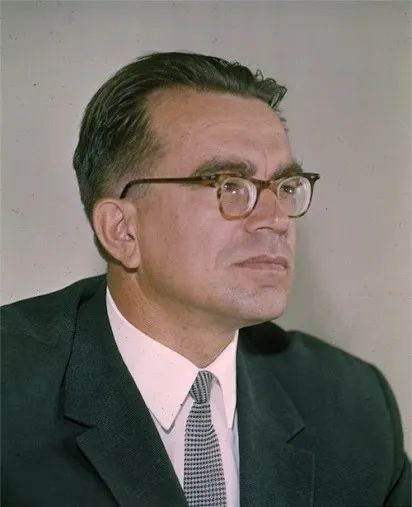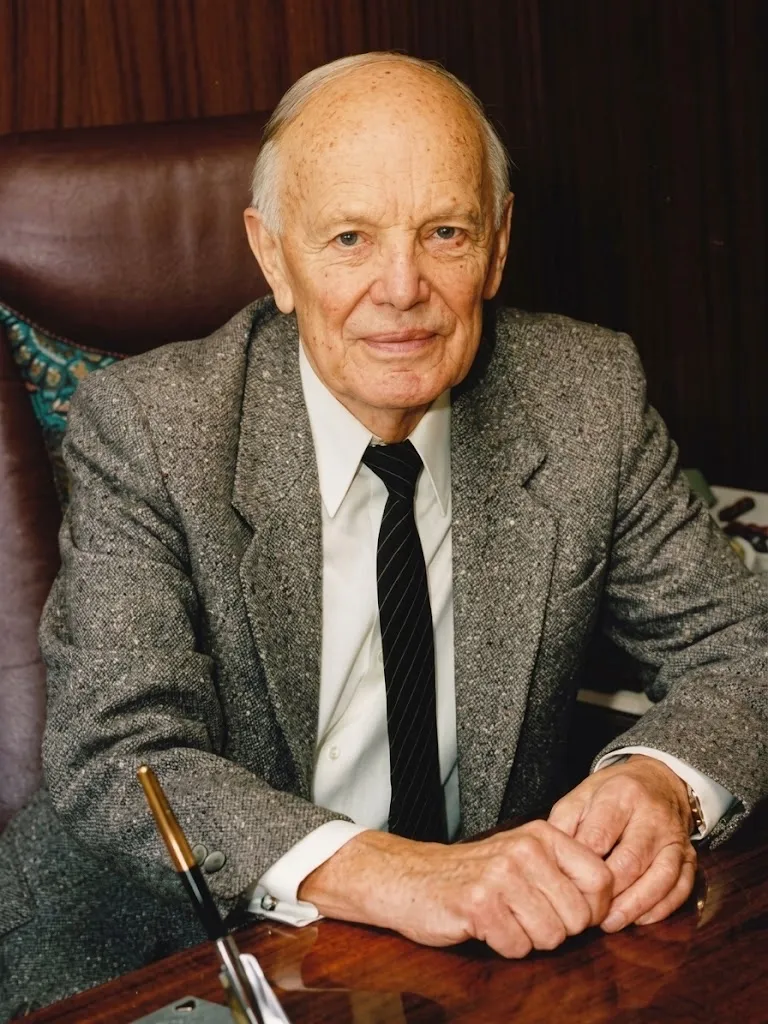
Lubomyr Romankiw
IBM inventor and scientist
How do you make a magnetic head smaller, cheaper and ready for mass production? Lubomyr Romankiw and a colleague found an answer that changed how computers store data.
Key accomplishments
- Co-developed a thin-film magnetic head with David Thompson that could be manufactured at scale
- Held more than 65 patents and published over 150 scientific papers on materials, electrochemistry and data storage
- Named an IBM Fellow and inducted into the US National Inventors Hall of Fame in 2012
- Helped build Plast in Ukraine and supported Ukrainian scientific and civic communities
A head thinner than a hair
When you save a file to a hard drive, a tiny magnetic head writes the data. In the 1970s Lubomyr Romankiw and his colleague David Thompson developed a technology that made these heads much smaller and easier to manufacture at scale. Their work helped computers store more information on smaller disks.
From Zhovkva to Canada
Romankiw was born in Zhovkva in 1931. Near the end of the Second World War, his family left Ukraine; after years in Europe, they settled in Canada. At school he traded knowledge: he helped classmates with science and maths, and they helped him learn English. In 1957 he earned a bachelor’s degree at the University of Alberta.
He continued at the Massachusetts Institute of Technology, where he earned a doctorate in metallurgy and materials science in 1962. That year he joined IBM’s research centre. He wanted to combine the properties of materials with precise manufacturing so that computers could store more data in less space.
He studied magnetic materials, thin films and electrodeposition - putting down metal with an electric current. This mix of chemistry, physics and engineering became the foundation for his work on new electronic components.
Making thousands of matching heads
Magnetic heads of the time were assembled by hand, making each one complex and costly. Romankiw and Thompson looked for a way to build them in thin layers, using electrochemistry and photolithography - methods that place materials on a surface with precision. Romankiw recalled that their process could produce about a thousand matching heads on a small area, instead of only a few dozen.
Their joint invention was not a single flash of inspiration: practical production called for new materials, a way to apply coatings and precise techniques for shaping each layer. In 1979, thin-film heads were first used in IBM’s 3380 storage system. They increased recording density and lowered the cost of storing data.
Thin-film technology later provided a foundation for new generations of magnetic heads. Their small size mattered, but so did the process: it made precise, repeatable manufacturing possible at the scale mass-produced devices required. An engineering solution from the lab changed how computers and other digital devices recorded and read data.
Science as a shared game
Romankiw worked across magnetic materials, thin films, electrochemistry and the manufacture of electronic components. He became an IBM Fellow, a distinction for the company’s leading researchers, and co-invented dozens of patented technologies. In 2012 he and David Thompson entered the US National Inventors Hall of Fame for their contribution to the thin-film magnetic head.
Outside the lab, Romankiw gave much of his time to Plast. He became one of the organisation’s leaders, supported the scouting movement in Ukraine and helped organise camps and jamborees. In 2008 Ukraine awarded him the Order of Prince Yaroslav the Wise for his contribution to the Ukrainian Plast movement.
Why it matters today
Romankiw showed how fundamental knowledge about materials can become a technology used by millions. His story connects Ukrainian roots, world-class science and service to a community. Anyone who takes on a hard problem, works with others and shares the result carries that tradition forward.