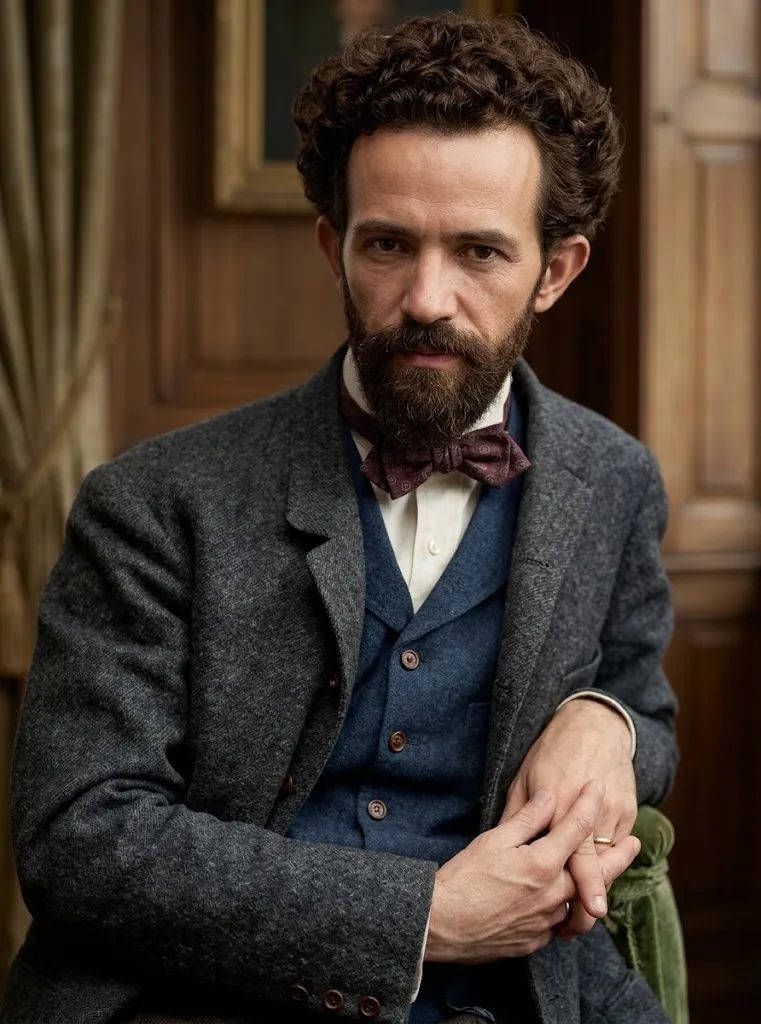
Arkhyp Kuindzhi
Landscape painter, master of light
In 1880 thousands of people came to a hall in St Petersburg to see a single painting: Moonlit Night on the Dnipro. Arkhyp Kuindzhi, a Greek from Mariupol who started out retouching photographs, became a celebrated master of landscape and left his fortune to young artists.
Key accomplishments
- Moonlit Night on the Dnipro (1880): the first single-painting exhibition in St Petersburg, seen by about 13,000 people in two weeks
- Ukrainian landscapes: The Chumak Road in Mariupol (1875), Ukrainian Night (1876), Evening in Ukraine (1878), The Dnipro in the Morning (1881)
- Snow (1873): a bronze medal at the international exhibition in London (1874)
- Professor (from 1892) and academician (from 1893) of the St Petersburg Academy of Arts; head of its landscape studio (1894–1897)
- Founder of an artists' society named after him (1909), to which he left his money, paintings and his estate in Crimea
One painting in a dark hall
Can a single painting draw thousands of people? In 1880 in St Petersburg Arkhyp Kuindzhi showed Moonlit Night on the Dnipro in a completely darkened hall, with the canvas lit only from the side. The moon over the river glowed so brightly that one newspaper even claimed an electric lamp was hidden behind the canvas. About 13,000 people saw the painting in two weeks, and Grand Duke Konstantin bought it for 5,000 roubles. For his dark tones the artist used asphalt-based paints, and over time they changed on the canvas.
An orphan from Mariupol
A goose-herd who dreamed of studying under Aivazovsky. Kuindzhi was born on the outskirts of Mariupol, in the Karasu quarter, to a Greek shoemaker’s family, in 1841 or 1842 according to different sources. His parents died early, and the boy herded geese, helped on a church building site and worked as a servant for a grain merchant. In 1855 he set off for Feodosia to study under Ivan Aivazovsky, but the master was away, and he was asked to paint a fence. Back home, Arkhyp retouched photographs in studios in Mariupol, Odesa and Taganrog. In the mid-1860s he went to St Petersburg and, after several attempts, became an auditing student at the Academy of Arts.
Ukraine on canvas
In St Petersburg Kuindzhi grew close to Ivan Kramskoi and Ilya Repin, and in the 1870s he belonged to the Peredvizhniki, the society of travelling exhibitions. Many of his paintings show Ukrainian nature: The Chumak Road in Mariupol, Ukrainian Night, Evening in Ukraine, The Dnipro in the Morning. In 1874 his Snow won a bronze medal at the international exhibition in London, and in 1878 three of his paintings were shown at the World’s Fair in Paris. With the play of daylight and moonlight he created a true optical illusion.
Silence at the height of fame
After his second solo exhibition, in 1882, Kuindzhi did not show new work to the public for almost thirty years, although he kept painting a great deal. He grew wealthy and helped poor students and artists. In 1894–1897 he ran the landscape studio of the Academy of Arts, but he was dismissed for supporting a student strike. His students included Nicholas Roerich and Konstantin Bogaevsky. In 1909 he founded an artists’ society named after him and left it his money, paintings and his estate in Crimea. Kuindzhi died in St Petersburg on 24 July 1910.
A museum that is gone
The staff of Mariupol’s Kuindzhi Art Museum managed to hide his originals. The building itself was destroyed by a russian airstrike in March 2022, during the siege of the city. But according to the city council, the occupiers later took them, along with other exhibits from Mariupol’s museums, to Donetsk. In 2023 the Metropolitan Museum of Art in New York changed the label on its Kuindzhi painting: it now names the artist as Ukrainian.
Debates and assessments
For a long time Kuindzhi was counted among russian artists, because he lived, studied and exhibited in St Petersburg, the capital of the empire. Ukrainian art historians stress that he was born and grew up in Mariupol and painted Ukrainian landscapes all his life, the Dnipro above all. Other scholars caution that the artist himself left no clear statement of his national identity. By origin he was a Greek from Mariupol’s Greek community, whose ancestors had been resettled from Crimea.
Why it matters today
A boy who herded geese on the edge of Mariupol, with no wealthy parents and hardly any schooling, learned to paint light so well that thousands came to see a single picture of his. He showed the world the Dnipro, the Ukrainian night and the steppe, and it was these paintings that made him famous. He left his fortune to young artists, so that their road would be easier than his. The museum destroyed in Mariupol is a reminder that russia also wages war on memory, and Kuindzhi’s return to Ukrainian art shows that this memory can be defended.