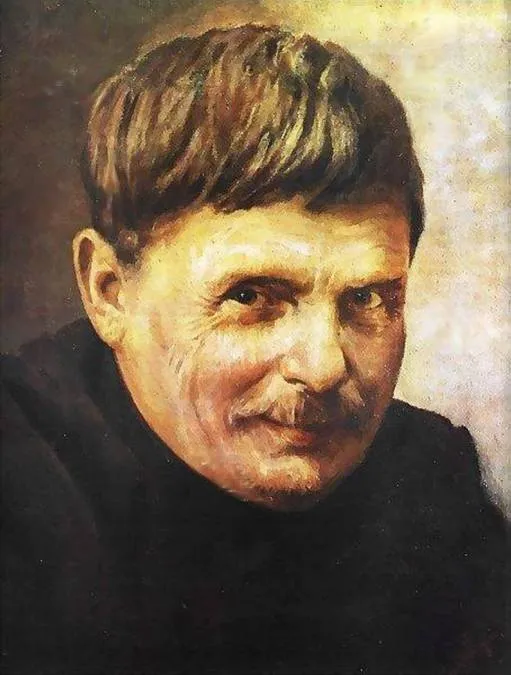
Mykola Pymonenko
Painter of the Ukrainian village
In 1909 in Paris a Kyiv painter's Hopak won a gold medal and was bought by the Louvre. Mykola Pymonenko, an icon painter's son from Priorka, spent more than a quarter of a century painting the Ukrainian village: weddings, fortune-telling, harvests, fairs. He trained a generation of Kyiv artists.
Key accomplishments
- Hopak (1908): a gold medal in Paris in 1909; the painting was bought by the Louvre
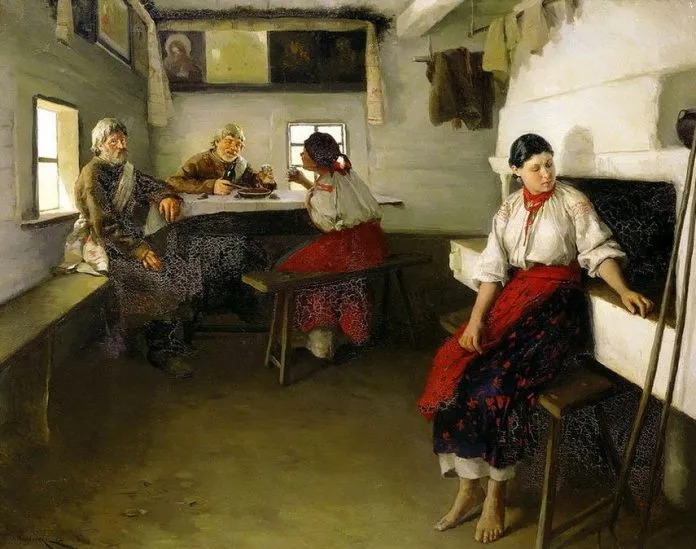
- A Wedding in Kyiv Province (1891), Fortune-Telling and The Matchmakers (1893), Kyiv Flower Seller (1897), Victim of Fanaticism (1899), Rivals (1909)
- Murals in St Volodymyr's Cathedral in Kyiv (1885–1896)
- Taught at the Kyiv Drawing School (1884–1900), co-founded the Kyiv Art School (1900), taught at the Kyiv Polytechnic Institute (1900–1912)
- Academician of painting of the St Petersburg Academy of Arts (1904); member of the Paris International Association of Arts and Letters (1909)
A Hopak for the Louvre
Did you know that a painting of a Ukrainian dance ended up in the Louvre? In 1909 in Paris, Hopak by the Kyiv painter Mykola Pymonenko won a gold medal, and the Louvre bought the canvas straight away. That same year Pymonenko was elected a member of the Paris International Association of Arts and Letters. By then he had been painting the Ukrainian village for more than twenty years: weddings, fortune-telling, matchmaking, harvests, fairs.
An icon painter’s son from Priorka
Pymonenko was born on 9 March 1862 in Priorka, then a suburb of Kyiv. His father Korniliy was a woodcarver who ran a small icon-painting workshop. As a boy, Mykola travelled with him to villages where his father worked in churches, grinding paints and lending a hand. In 1878 Pymonenko entered the Kyiv Drawing School of the painter Mykola Murashko. In 1882 he went to study at the St Petersburg Academy of Arts, where his teachers included Ilya Repin, but two years later illness and lack of money brought him back to Kyiv.
A teacher for a whole generation
For more than a quarter of a century Pymonenko taught others. From 1884 he taught at the Kyiv Drawing School, in 1900 he was one of the founders of the Kyiv Art School, and until the end of his life he taught drawing to future engineers at the Kyiv Polytechnic Institute. His students included Oleksandr Murashko and Fotii Krasytskyi, and Lesya Ukrainka also took drawing lessons from him. In 1885–1896, together with Viktor Vasnetsov and Mikhail Vrubel, he painted the murals of St Volodymyr’s Cathedral in Kyiv: the images of St Anne and St Nicholas are his.
The village on canvas
Pymonenko painted genre scenes, landscapes and portraits. The best known include A Wedding in Kyiv Province, Fortune-Telling, The Matchmakers, Kyiv Flower Seller and Rivals. Some told bitter stories, such as Victim of Fanaticism. From 1888 he spent every summer working in his studio in the village of Maliutianka near Kyiv; it is now his museum. In 1899 Pymonenko became a member of the Peredvizhniki, and in 1904 an academician of painting. He died in Kyiv on 26 March 1912 and was buried in the Lukianivka Cemetery.
Why it matters today
Mykola Pymonenko showed that an ordinary Ukrainian village, with its feasts, its work and its sorrows, is worthy of the world’s great museums: the Ukrainian dance he painted made it into the Louvre. He painted not tsars and battles but the people he saw every day, and through them the world saw Ukraine. As a teacher, he trained the artists who carried Ukrainian art further. Anyone who paints what is their own so that the world can see it carries on his work.