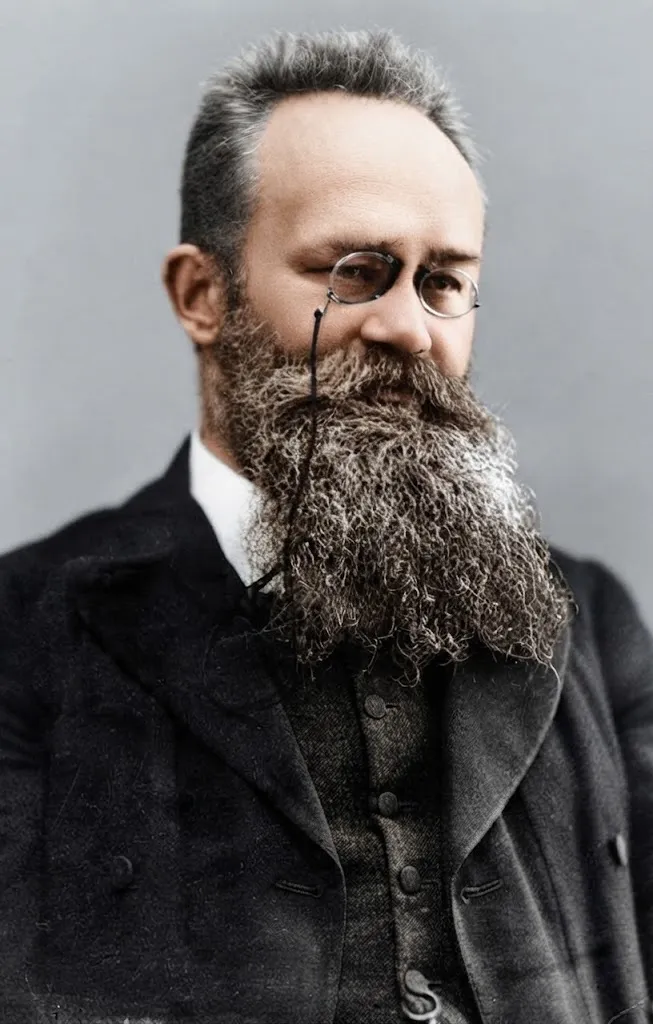
Vasyl Krychevskyi
Architect who drew the UNR coat of arms
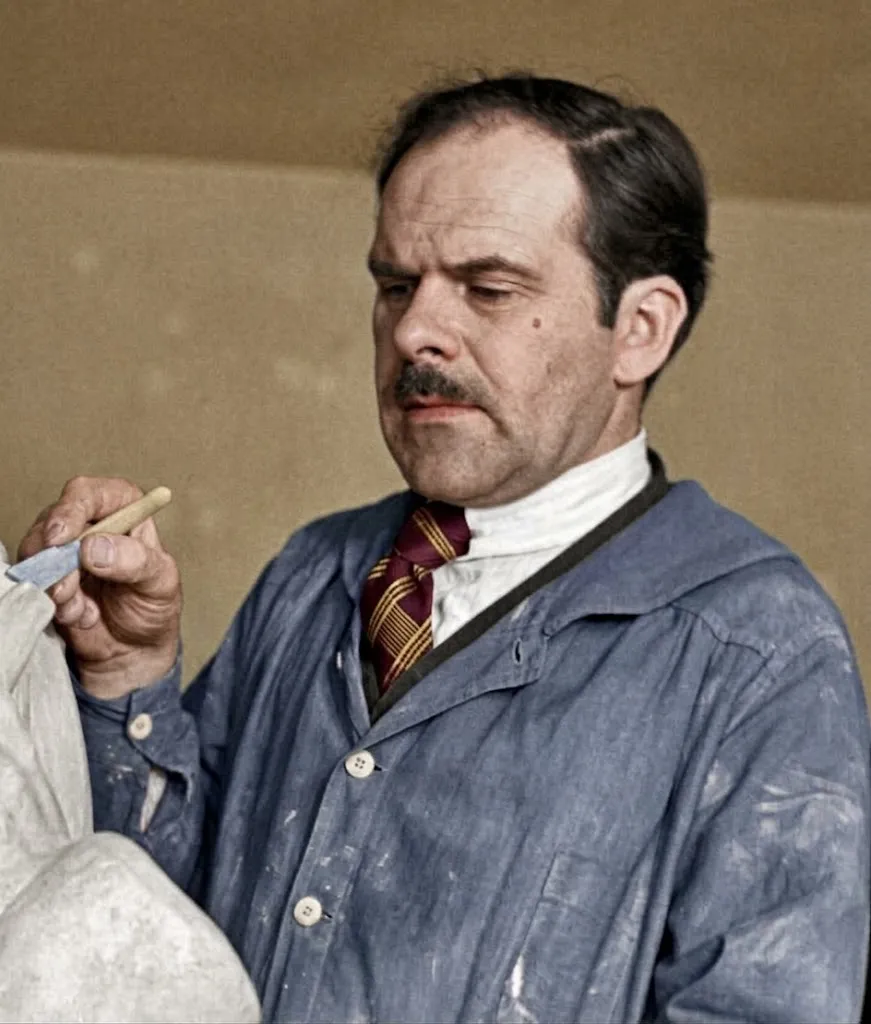
Ukraine’s trident today is very close to the one Vasyl Krychevskyi drew in 1918. A self-taught architect and artist, he designed the arms and seals of the Ukrainian People’s Republic, built the Poltava house that began Ukrainian Art Nouveau and was an early Ukrainian film designer.
Key accomplishments
- The great and small state coats of arms and seals of the Ukrainian People’s Republic, approved on 22 March 1918
- The UNR 2-hryvnia banknote (1918)
- The Poltava Provincial Zemstvo building (1903–1908), seen as the start of Ukrainian Art Nouveau architecture
- A co-founder and professor of the Ukrainian Academy of Arts (1917)
- Design for the films Taras Triasylo, Zvenyhora and The Fair at Sorochyntsi
- The Taras Shevchenko memorial museum by his grave in Kaniv (co-designer)
- Book design, including Mykhailo Hrushevskyi’s Illustrated History of Ukraine
An architect with no diploma
Did you know that the man who drew the coat of arms of the Ukrainian People’s Republic never earned an architect’s diploma? Vasyl Krychevskyi was born in 1873 in the village of Vorozhba, in today’s Sumy region, the eldest of eight children of a country medic. He finished a railway technical school in Kharkiv and taught himself art. He learned architecture in the offices of Kharkiv architects. In 1902 he built a real Sloboda Ukraine peasant house, down to the last detail, for the exhibition of an archaeological congress in Kharkiv.
The building that started Ukrainian Art Nouveau
Krychevskyi won the competition to design the building of the Poltava provincial zemstvo, the local council, in 1903. He took its shapes, proportions and details from folk architecture and covered the facade with coloured ceramics in old Ukrainian patterns. The building was finished in 1908, and it is considered the start of a new style, Ukrainian Art Nouveau. Today it houses the Poltava Museum of Local Lore, which bears Krychevskyi’s name.
Next door to Hrushevskyi
After moving to Kyiv, Krychevskyi painted sets for Mykola Sadovskyi’s theatre. He decorated the facade of Mykhailo Hrushevskyi’s house, later moved in there himself, and designed the historian’s books, among them the Illustrated History of Ukraine. At Varvara Khanenko’s carpet workshop he ran the work and drew many of the carpet designs himself. In 1917 he became a co-founder and professor of the Ukrainian Academy of Arts, alongside his brother Fedir, Heorhii Narbut, Oleksandr Murashko and Mykhailo Boichuk. Accounts differ: some say he was its first rector, others that he was elected but declined, and Fedir took the post.
A trident for a young republic
Hrushevskyi asked Krychevskyi to draw the young republic’s coat of arms: in February 1918 the Little Rada had decided that the emblem of the Ukrainian People’s Republic would be the trident, the sign of the Kyivan state in the time of Volodymyr the Great. That winter, when Bolshevik troops shelled Kyiv, Hrushevskyi’s house burned down, and with it Krychevskyi’s folk-art collection and many of his designs for money and stamps. Even so, on 22 March 1918 the Little Rada approved his great and small coats of arms and seals: a trident inside an ornamental wreath. His design was also used for the 2-hryvnia banknote. Heraldry experts, Narbut among them, criticised the sketches: Krychevskyi was no heraldist. Yet his form of the trident is the one that stuck. When independent Ukraine adopted its small coat of arms in 1992, its designers built on Krychevskyi’s work, so today’s arms are very close to the 1918 design.
From Dovzhenko to Kaniv
Krychevskyi became a film designer in the 1920s: at the Odesa film studio he designed Taras Triasylo, Taras Shevchenko and Oleksandr Dovzhenko’s Zvenyhora. He helped restore the Kyiv house where Taras Shevchenko had lived. In 1934 he also designed Rolit, a strikingly modern, constructivist house for writers in Kyiv. With the architect Petro Kostyrko he created the museum by Shevchenko’s grave in Kaniv.
The road to Caracas
Krychevskyi left Kyiv for the west in 1943. In Lviv he headed the Higher Art Studio, then lived in Austria and France, and in 1948 he moved to his daughter’s home in Caracas, the capital of Venezuela. There he painted his home village of Vorozhba from memory and worked on an album of Ukrainian peasant houses. He died in Caracas on 15 November 1952. In 1975 his remains were moved to the Ukrainian cemetery in South Bound Brook, in the United States. In 2005 his work was entered in Venezuela’s national encyclopedia.
Why it matters today
Vasyl Krychevskyi proved that folk art, from village houses and carpets to ceramic patterns, could become the language of modern architecture, books, film and even a state. The trident he drew for the Ukrainian People’s Republic in a matter of weeks lives on in Ukraine’s coat of arms today, linking the republic of 1918 with independent Ukraine. His Poltava building showed that a Ukrainian style could be modern, not only something for museums. And his life tells anyone who doubts themselves that without a diploma, but with curiosity and hard work, you can give a whole country its face.