Oleksa Dovbush
Leader of the Carpathian opryshky
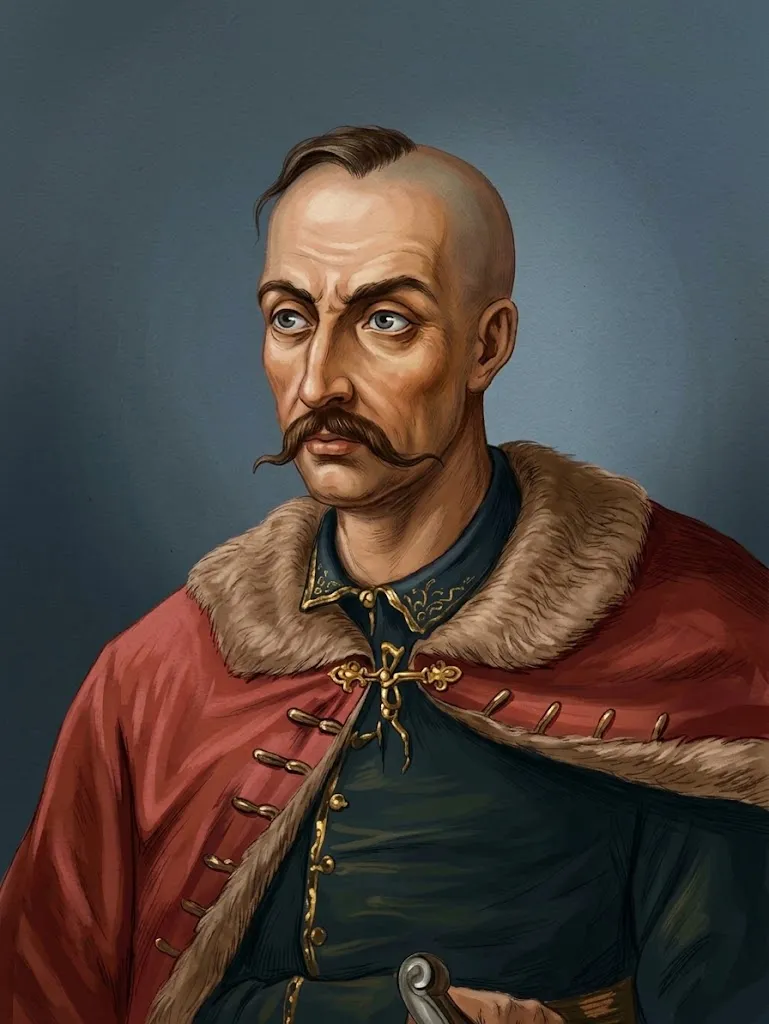
The records cover just eight years of his life, from 1738 to a gunshot in Kosmach in 1745. The people wrote the rest. Oleksa Dovbush led his outlaws across the Carpathian foothills and mountains, and became the hero of Hutsul legends, of books by Franko and Khotkevych and of a 2023 film.
Key accomplishments
- Leader of an outlaw (opryshok) band in 1738–1745, the best known of the Carpathian opryshky
- From 1740, a camp on Mount Stih, from which the band raided Pokuttia, Bukovyna and Transcarpathia
- Took the fortress of Bohorodchany (1744)
- Evaded for years the troops sent after him by the Polish crown hetman Józef Potocki
- Hero of Hutsul folklore, of works by Ivan Franko, Yurii Fedkovych and Hnat Khotkevych, and of the film Dovbush (2023)
A poor man’s son from Pechenizhyn
What do we know for sure about the hero the Carpathians know from their songs? Oleksa Dovbush was born in 1700 in Pechenizhyn, near Kolomyia. His father was a komirnyk, one of the poorest villagers, who had no house of their own and rented a corner in someone else’s. Dovbush first appears in the records in 1738, already leading a small band. With his brother Ivan he raided noblemen, leaseholders and moneylenders. In the spring of 1739 the brothers quarrelled, Ivan wounded Oleksa in the leg with an axe, and from then on each went his own way.
The camp on Mount Stih
Under pressure from the nobility, the band of several dozen outlaws moved into the mountains in 1740 and made camp on Mount Stih, where the borders of Poland, Moldavia and Hungary met. For years the Polish crown hetman Józef Potocki sent troops after them, and one detachment took the camp by surprise and killed many of the men. Even so, in 1744 Dovbush’s band captured the fortress at Bohorodchany.
A shot in Kosmach
Dovbush is no invention but a real man: records of those years survive, from interrogation reports to court entries. The end came in Kosmach: on 24 August 1745 he was shot there by a well-off villager, Stepan Dzvinchuk. His companions left him behind, and he died by morning.
Where the records end and the legend begins
In songs and folk tales Dovbush takes from the rich and gives to the poor, hides treasure in the mountains, and dies betrayed by his lover Dzvinka. Caves and rocks across the Carpathians bear his name. Ivan Franko’s first novella, Petrii i Dovbushchuky, grew out of folk stories about Dovbush. Yurii Fedkovych wrote about him too, and Hnat Khotkevych gave the name Dovbush to both a play and a novella. In 2023 Oles Sanin made the film Dovbush.
Debates and assessments
Some scholars write that Dovbush gave a good part of his loot to the poor, and that this is why the villagers loved him. Others note that the records hold very few such cases, and that the band robbed anyone poorly defended, Ukrainians included. In their view, the image of a fighter against serfdom or for national liberation was created later, by 19th- and 20th-century writers and by Soviet cinema.
Why it matters today
Dovbush shows how a people chooses its own heroes: out of an outlaw’s eight years, the Hutsuls made a story about justice and about a man who would not bow to the lords. That story inspired Franko, Fedkovych and Khotkevych, and it still fills cinemas today. And knowing where the legend ends and the records begin lets us love our heroes without making things up for them.