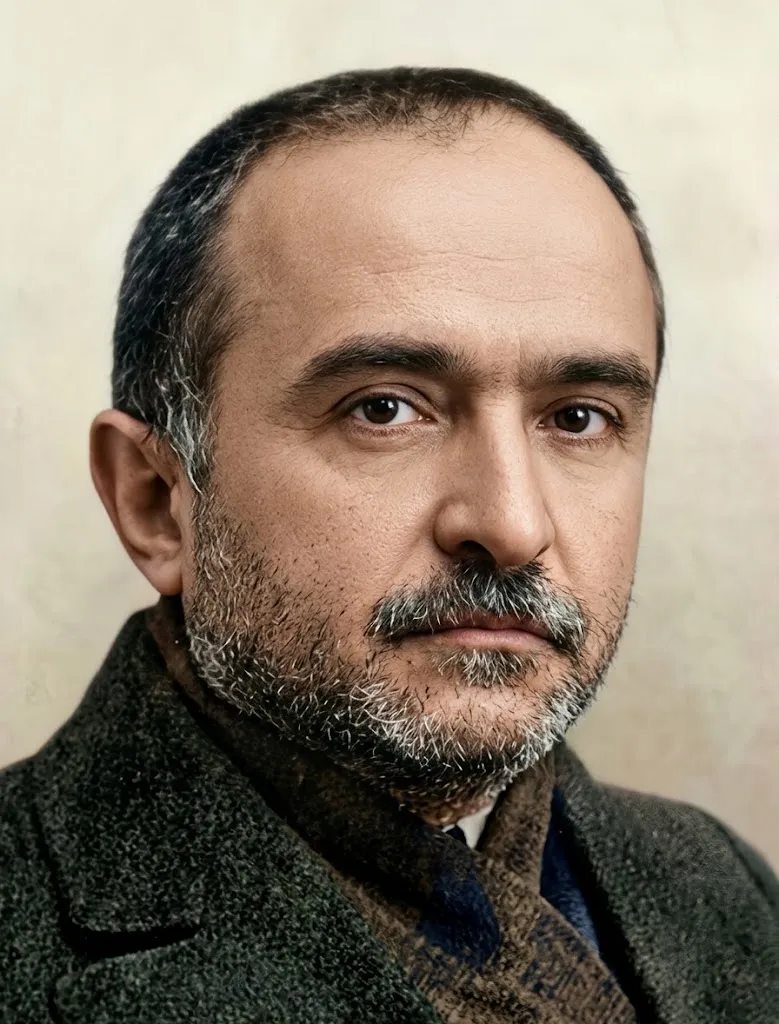
1870–1953
Yevhen Paton
Bridge builder, pioneer of welding
At almost 60, a famous bridge builder started over and took up welding. Yevhen Paton founded the Institute of Electric Welding in Kyiv, and under his direction Europe’s largest all-welded road bridge was built: the Paton Bridge across the Dnipro.
Key accomplishments
- About 35 bridge designs, including rebuilding bridges across the Dnipro in Kyiv after the revolution
- Founded the Institute of Electric Welding (1934) and led it until 1953
- High-speed automatic submerged-arc welding, ten times more productive than welding by hand
- Automatic welding of tank armour during the Second World War
- The Paton Bridge in Kyiv (1953), Europe’s largest all-welded road bridge
The boy from Nice
Yevhen Paton was born in 1870 in Nice, where his father was the russian consul. He graduated from the polytechnic in Dresden (1894), but the russian empire didn’t recognize foreign degrees. So Paton took the exams at the St Petersburg Institute of Railway Engineers and earned a second diploma in 1896.
Bridges for Kyiv
Paton was invited to the Kyiv Polytechnic Institute in 1904, and there he headed the department of bridges. Over his career he produced about 35 bridge designs and wrote textbooks on bridge building. After the revolution he rebuilt destroyed bridges, among them a bridge across the Dnipro in Kyiv that opened in 1925.
Starting over at almost 60
Paton was elected to the Academy of Sciences in 1929. That same year, at almost 60, he took up something new. Bridges were then held together by rivets, and Paton believed the future lay in welding, which was still poorly understood. He set up an electric welding laboratory at the Academy, and in 1934 turned it into the Institute of Electric Welding, which he led for the rest of his life. His team developed high-speed automatic submerged-arc welding, ten times more productive than welding by hand.
Welding for the war
In the Second World War the institute was evacuated to Nizhny Tagil in the Urals. There Paton and his staff set up automatic welding of tank armour and a production line for tank hulls. In 1943 he became the first Ukrainian academician to be named a Hero of Socialist Labour. From 1945 to 1952 Paton was vice-president of the Academy of Sciences of the Ukrainian SSR.
The bridge he never saw
Paton’s last great project was a bridge across the Dnipro in Kyiv, about one and a half kilometres long: Europe’s largest all-welded road bridge. Yevhen Paton died on 12 August 1953, less than three months before it opened, and the bridge was named after him.
Why it matters today
Yevhen Paton proved it is never too late to start something new: at almost 60, a famous bridge builder took up welding, then poorly understood, because he saw the future in it. The bet paid off: his team’s technology helped the country through the war, and the Paton Bridge in Kyiv showed what it could do. He left behind not just an institute but a school of science, carried on by his son, Borys Paton, who later led the Academy of Sciences of Ukraine. Anyone who fears it is too late to take up something new can remember Paton.