1929–2000
Halyna Zubchenko
Muralist of the Sixtiers
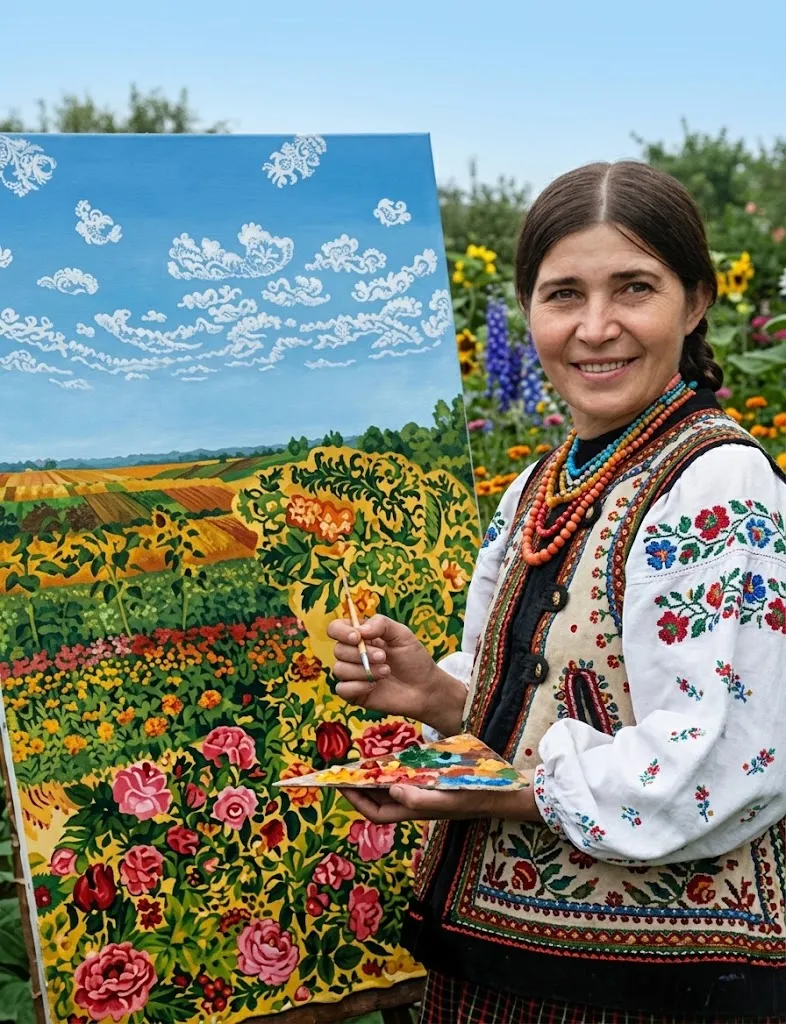
Examiners made her re-dress the Hutsuls in her diploma painting and add a Soviet soldier; her stained-glass Shevchenko was destroyed as “ideologically hostile”. Halyna Zubchenko, a Sixtiers artist, found Ukraine in the Carpathians and folk art and made mosaics for Kyiv, Donetsk and Mariupol.
Key accomplishments
- The diploma painting Hutsul Wedding (1959), now in the Ivan Honchar Museum in Kyiv
- Co-founder of the visual arts section of the Club of Creative Youth in Kyiv (1962)
- Co-author of the stained-glass window Shevchenko. Mother at Kyiv University (1964), destroyed as “ideologically hostile”
- Mosaics for School No. 5 in Donetsk (1965) and Tree of Life and Kestrel in Mariupol (1967, with Alla Horska’s team)
- With Hryhorii Pryshedko, the mosaics Blooming Ukraine (Mariupol, 1967), Movement (1969), Blacksmiths of Modernity (1974) and Masters of Time (Institute of Cybernetics, Kyiv)
- Carpathian paintings, Crimean Watercolours, the Lavra cycle and the icon The Saviour Not Made by Hands
A box of glass
On the windowsill of Halyna Zubchenko’s studio stood a wooden box full of coloured pieces of mosaic glass, called smalt. “That’s from St Michael’s Golden-Domed,” the artist would explain. The Bolsheviks tore the monastery down before her eyes. As a girl she walked with her mother past the fenced-off ruins and, although her mother scolded her, sneaked through a gap in the fence to collect pieces of the old mosaics.
Two grandfathers taken by the state
Halyna was born in Kyiv in 1929 into a family of scholars. One grandfather, the priest Andrii Skrypchynskyi, was arrested; the other, a farmer, was dispossessed as a “kulak”. Her drawing lessons came from a family friend, Okhrim Kravchenko, an artist of Mykhailo Boichuk’s school.
A wedding that had to change clothes
At the Kyiv Art Institute her first independent painting, The Overthrow of Perun, got a failing mark: the event, she was told, had been shown in an “ideologically incorrect” way. In 1956 Halyna went to the Carpathians for the first time on a summer placement and fell for the Hutsul highlands for life.
Her diploma work was Hutsul Wedding (1959). The examining board kept demanding changes: some figures had to go, others were re-dressed in the costume of Ukraine’s Dnipro region, and a Soviet liberator-soldier was added, to show the “unity” of western and eastern Ukraine. She didn’t want to defend a diploma like that, but with the support of her teacher Oleksii Shovkunenko she did.
The Shevchenko that enraged officials
In 1962, with Alla Horska, Halyna Sevruk, Liudmyla Semykina and Viktor Zaretskyi, Zubchenko set up the visual arts section of the Club of Creative Youth, led by Les Taniuk, and decided to give her life to Ukrainian monumental art.
In 1964 she, these women artists and Opanas Zalyvakha made the stained-glass window Shevchenko. Mother for Kyiv University: the poet embraced a wronged woman, Ukraine. Officials were furious. The window was destroyed as “ideologically hostile”, and its authors came under pressure.
Mosaics finished while friends were arrested
In 1965 Zubchenko was commissioned to make mosaics for School No. 5 in Donetsk, and she brought in Horska and Hryhorii Synytsia. Meanwhile in Kyiv, Zalyvakha and Ivan Svitlychnyi were arrested. The artists finished the work anyway.
A falcon instead of a fighter bird
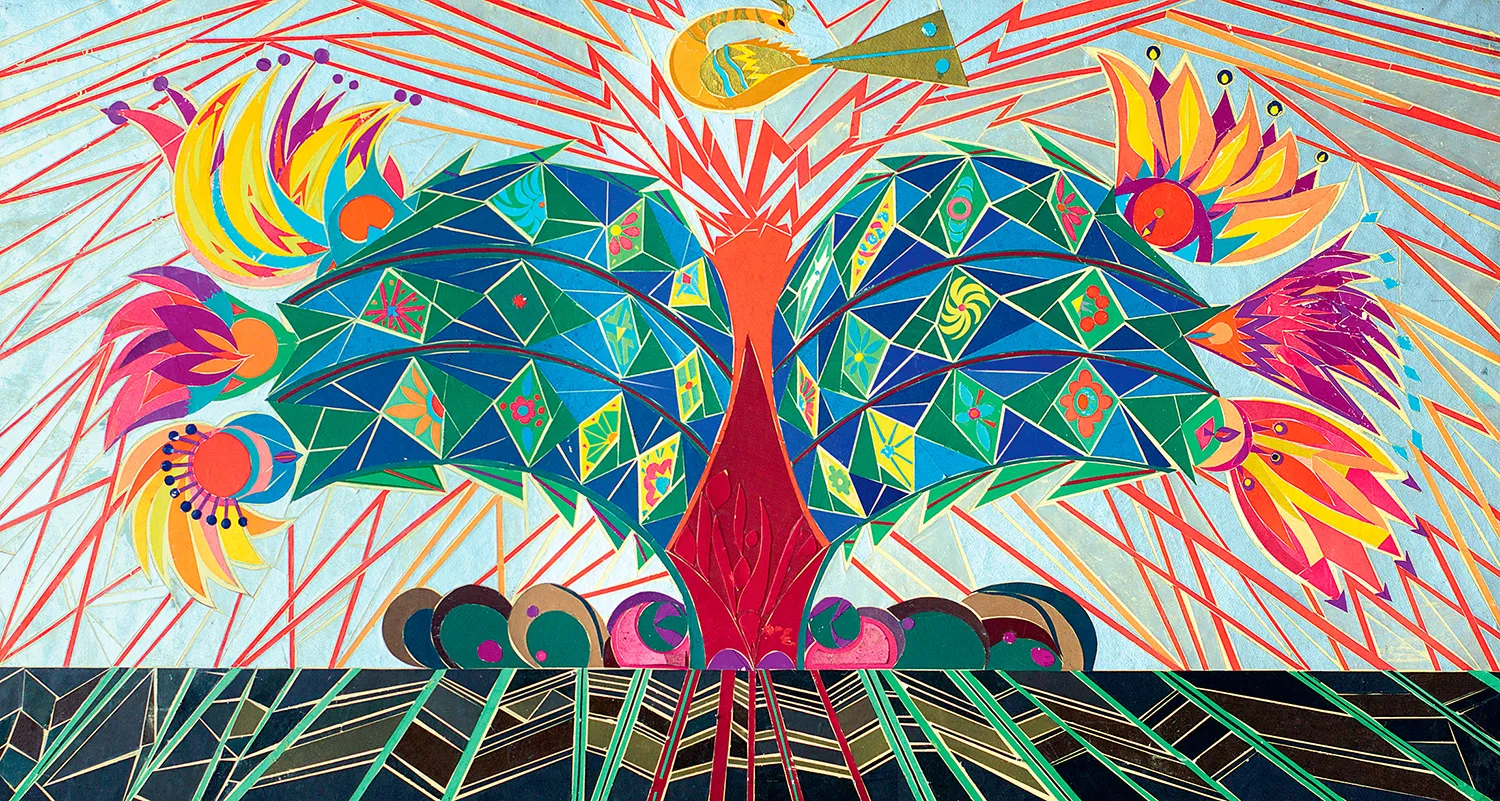
In 1967 Horska’s team, Zubchenko among them, took less than two months to decorate the Ukraina restaurant in Mariupol with the mosaics Tree of Life and Kestrel. Kestrel was meant to be textbook socialist realism, but the artists, at their own risk, made it a light, swift composition with a falcon. After Horska’s death Tree of Life was bricked up, and nobody saw it again until 2008. In 2022 russian shelling destroyed both mosaics.
Divers against the sun
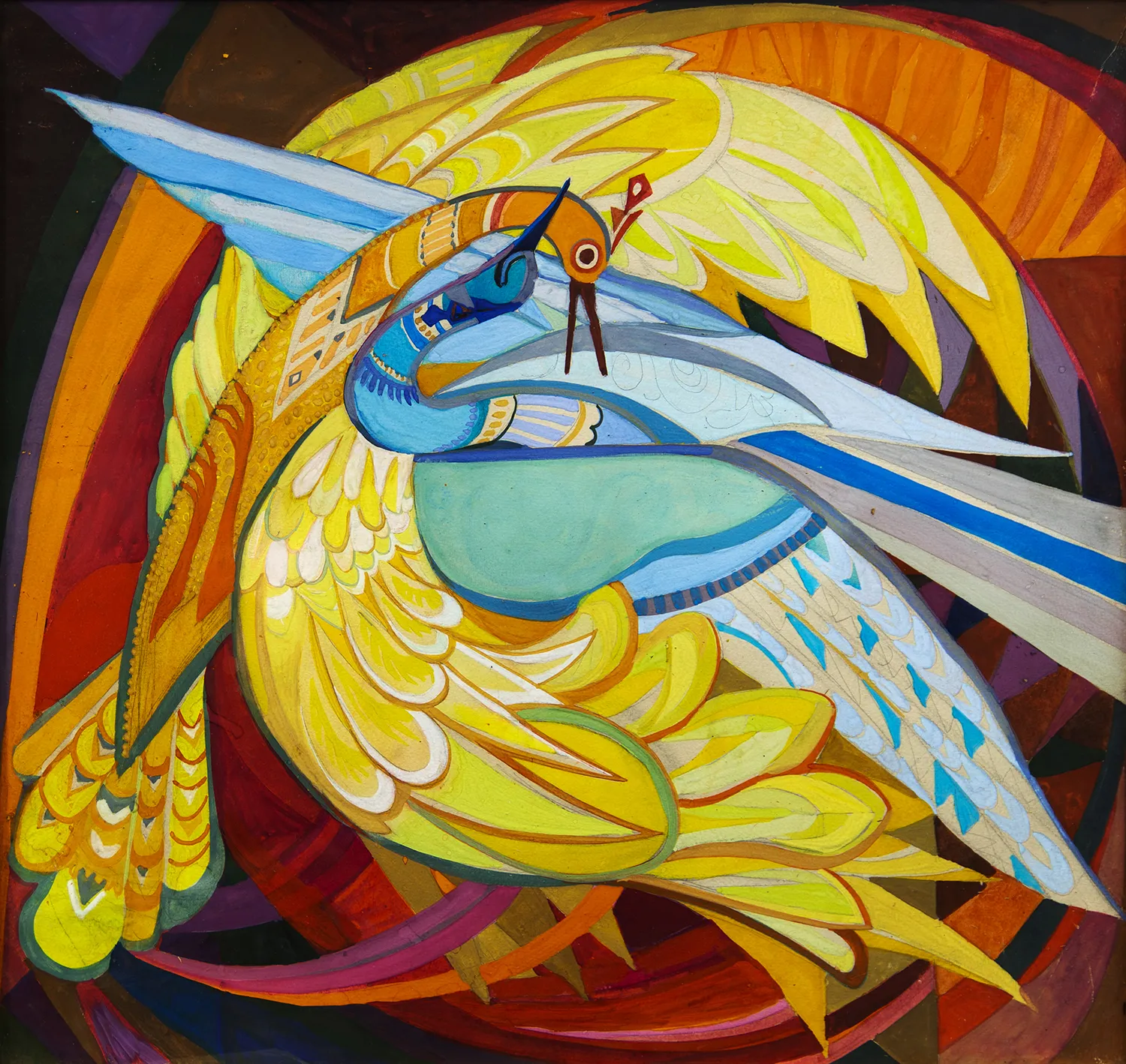
That same year Zubchenko and the Mariupol artist Hryhorii Pryshedko, who became her husband, laid the 60-square-metre Blooming Ukraine from Horska’s sketch. In the couple’s Kyiv mosaic Movement (1969), three athletes dive into water against a sun-flower: with it they found a style of their own. After her husband died, Zubchenko carried on alone, and on the easel in her studio stood The Legend of Fidelity, two birds woven into one, in his memory.
Back to the mountains
Only in 1985, after a long break, did she go back to the Carpathians and return to painting. In the 1990s she painted the Kyiv Lavra, Crimean watercolours and an icon, and near the end of her life she ran a children’s art studio, Oranta, at the Kyiv Polytechnic Institute. Her paintings are in museums and collections in eight countries, from Croatia to Japan. Halyna Zubchenko died in Kyiv in 2000.
Why it matters today
Halyna Zubchenko believed Ukrainian art could be built on folk art, and she looked for it where it still lived: in Hutsul villages, in ornament, in the glass of old Kyiv. She did not give up when her paintings were “corrected” and her window destroyed, and with her Sixtiers friends she gave Soviet walls a Ukrainian voice. Russia has destroyed some of those mosaics in Mariupol, so each one that survives is memory worth protecting. Anyone who looks for themselves in folk art today is walking her path.