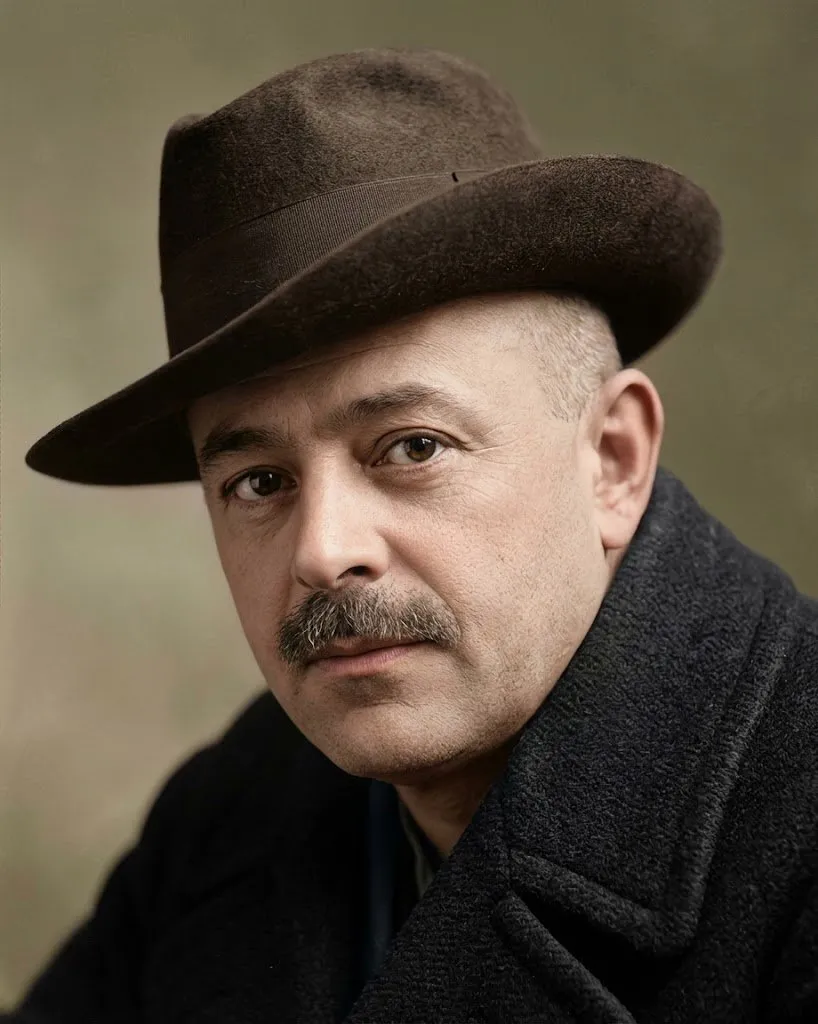
Olena Kulchytska
Graphic artist and painter
She had to go to Vienna to study art: few schools then took women. Olena Kulchytska from Berezhany became the first professionally trained woman artist in western Ukraine and left more than 6,000 works: etchings, linocuts, illustrations for Franko and Kotsiubynskyi, hundreds of folk-costume studies.
Key accomplishments
- More than 6,000 works: paintings, watercolours, etchings, linocuts, woodcuts, ex libris, book illustration
- Illustrations for Ivan Franko's Fox Mykyta, Mykhailo Kotsiubynskyi's Shadows of Forgotten Ancestors, and works by Vasyl Stefanyk and Yurii Fedkovych
- With her sister Olha, made about 80 kilims to her own designs; designed furniture, enamels and ceramics
- Watercolour albums Folk Dress of the Western Oblasts of the Ukrainian SSR and Folk Architecture of the Western Oblasts of the Ukrainian SSR
- Taught drawing at a gymnasium in Peremyshl for almost 30 years (until 1938); after the war taught at the Lviv Polygraphic Institute
- People's Artist of the Ukrainian SSR (1956), deputy of the Supreme Soviet of the Ukrainian SSR for two terms, Shevchenko State Prize of the Ukrainian SSR (1967)
Why a Galician girl went to Vienna to study
Where could a girl from Galicia train as an artist in the early 1900s? Hardly anywhere: most schools would not take women. Olena Kulchytska was born on 15 September 1877 in Berezhany, a lawyer’s daughter. In 1903 she enrolled at the Vienna school of applied arts, which did admit women. She is considered the first professionally trained woman artist in western Ukraine. An enamelled casket she made won her a prize, and the money took her to the museums of Paris, Munich and London.
“A new force” from Peremyshl
When she held her first exhibition, in Lviv in 1909, Ivan Trush hailed it as the arrival of a serious new force in Ukrainian art. Kulchytska then spent almost thirty years teaching drawing at a gymnasium in Peremyshl. There she took up printmaking: etchings, linocuts, woodcuts, bookplates. With her sister Olha she made about 80 kilims, and craftsmen in Kosiv built furniture to her designs.
Fox Mykyta and the Hutsuls
Most of her drawings are in children’s books. She illustrated Ivan Franko’s Fox Mykyta, Mykhailo Kotsiubynskyi’s Shadows of Forgotten Ancestors and works by Vasyl Stefanyk, with whom she corresponded. Shortly before the Second World War she moved back to Lviv and went to work at the Ethnographic Museum. When the Soviet authorities wanted to split up her flat, the museum’s director, Filaret Kolessa, stood up for her. Kulchytska travelled through Carpathian villages sketching folk dress and houses, and these trips became her albums of watercolours.
Titles and suspicion
After the war she headed the graphics department at the Lviv Polygraphic Institute. In 1951, though not a Party member, she was elected to the Supreme Soviet of the Ukrainian SSR, and in 1956 she was named People’s Artist of the Ukrainian SSR. Yet in the early 1950s she was removed from teaching, accused of “nationalism”. She left her artistic estate to the National Museum in Lviv. She died on 8 March 1967, and in 1971 a memorial museum opened in her flat.
Debates and assessments
A memorial plaque appeared in 2020 on the house in Peremyshl where she had lived, but it was never officially unveiled: Poland’s Institute of National Remembrance called her name a promotion of communism. In February 2021 the plaque was smashed. Ihor Horkiv, head of the Peremyshl branch of the Association of Ukrainians in Poland, blamed a campaign of lies against the artist and saw hatred of Ukrainians behind attempts to erase part of Peremyshl’s past. Liubov Kost, head of her museum, stresses that the artist never joined the Party and never glorified Soviet reality. The art historian Iryna Hakh sees the seat in the Supreme Soviet as a political move by the Soviet authorities.
Why it matters today
Olena Kulchytska proved that a woman from Galicia could become a professional artist even when art schools kept their doors closed to women. She brought Viennese modernism together with folk ornament and showed that folk art can live on in modern prints, books and kilims. Her watercolours preserved the dress and houses of Carpathian villages, and her drawings brought Ukrainian tales closer to children. Anyone who takes an old pattern and makes something new from it carries on her work.