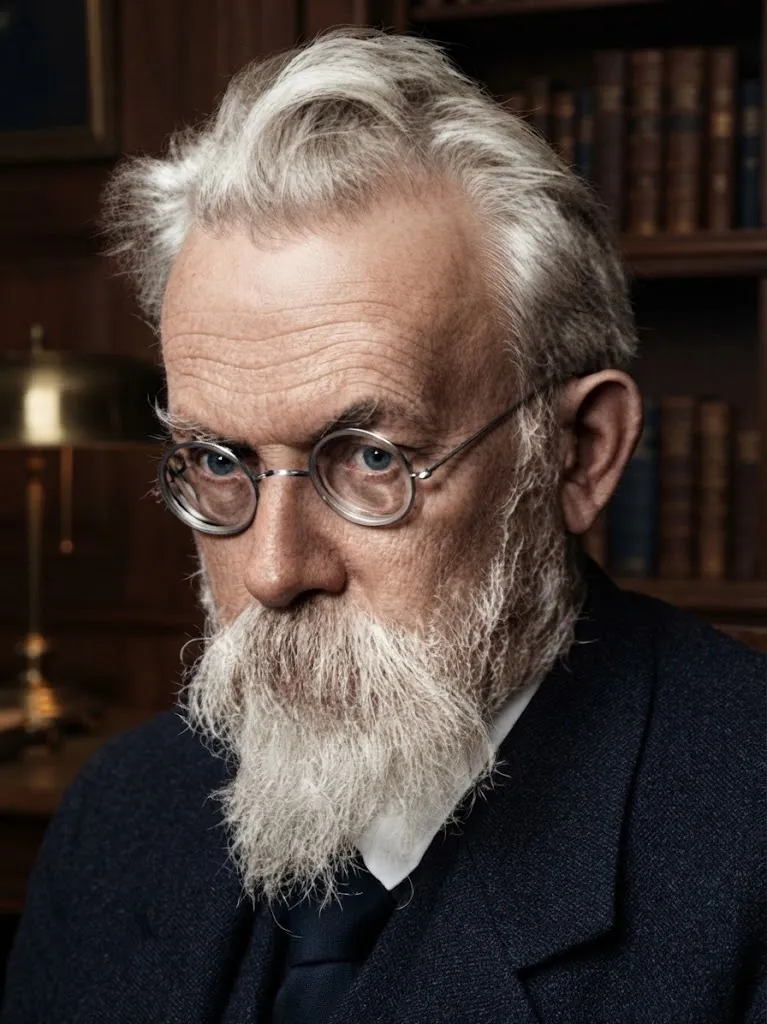
Oleksandr Potebnia
Linguist and philosopher of language
Do we think in words? Oleksandr Potebnia argued that language is how the mind comes to know the world, so a people cut off from its own language loses part of itself. A professor at Kharkiv University, he founded the Kharkiv school of linguistics and translated the Odyssey into Ukrainian.
Key accomplishments
- Thought and Language (1862), a study of how language and thinking are linked
- Professor at Kharkiv University (from 1874); founder of the Kharkiv school of linguistics
- President of the Kharkiv Historical-Philological Society (1877–1890)
- Wrote a Ukrainian primer for Sunday schools; collected folk songs on expeditions
- Explanations of Little Russian and Related Folk Songs (1883–1887)
- Began a verse translation of Homer's Odyssey into Ukrainian (fragments published in 1905)
- Corresponding member of the St Petersburg Academy of Sciences (1875)
- The Institute of Linguistics of the National Academy of Sciences of Ukraine bears his name
Can you think in someone else’s language as well as in your own?
Oleksandr Potebnia spent his life looking for the answer. He argued that language does not simply carry ready-made thoughts: it is through language that the mind sorts its impressions and comes to know the world. So for a person, and for a whole people, the mother tongue is the only full path to thinking for themselves. Hence his conclusion: denationalization, including the Russification of Ukrainians, breaks a person down spiritually and intellectually.
A farm boy schooled in Polish
A farm boy from the Romny area finished secondary school in the Polish town of Radom, where lessons were taught in Polish. Potebnia was born on 22 September 1835 at the Maniv farmstead near the village of Havrylivka, into a family of minor gentry descended from Zaporozhian Cossacks. After school he entered Kharkiv University, first to study law and then history and philology. That is where he began collecting Ukrainian folk songs.
A primer for Sunday schools
Potebnia belonged to the Kharkiv Hromada, a circle of Ukrainophiles, in the early 1860s. He wrote a Ukrainian primer for Sunday schools and went on folklore expeditions in the Poltava and Okhtyrka districts. In 1862 he published his main work, Thought and Language, on how language and thinking are connected. After it the young scholar was sent abroad for two years: he studied Sanskrit in Berlin and attended lectures in Vienna and Prague.
The professor who grew a school
Potebnia was a professor at Kharkiv University from 1874. Thanks to him Kharkiv became one of the leading centres of Slavic philology, and his students and followers formed the Kharkiv school of linguistics. He wrote his works and lectures in russian, but he studied the language of folklore as a record of a people’s worldview and history.
The Odyssey in Ukrainian
Potebnia spent the 1880s preparing the works of Hryhorii Kvitka-Osnovianenko for print and beginning to translate Homer’s Odyssey into Ukrainian. He did not live to finish it: fragments came out in Kharkiv in 1905. Nor did he see his essay “Language and Nationality”, in which he spoke out against denationalization, in print: it was published in 1895. Oleksandr Potebnia died in Kharkiv on 11 December 1891.
Why it matters today
Potebnia put into the language of science what many people feel: a mother tongue is not just words, it is a way of thinking and of seeing the world. That is why, for him, the language question was a question of whether a people would stay itself. His ideas still give arguments to anyone who chooses Ukrainian, teaches children in it and defends it from being pushed out. And his unfinished Odyssey showed that Ukrainian can carry even Homer.