Emma Andiievska
Poet, novelist and painter
Emma Andiievska grew up in a Russian-speaking family but chose Ukrainian as a child in Vyshhorod. In exile she wrote sonnets and novels in it, broadcast in it for forty years and painted more than 9,000 pictures.
Key accomplishments
- Published her first poetry collection, Poems, in 1951, at 20
- Spent 40 years (1955–1995) at Radio Liberty’s Ukrainian service as an announcer, scriptwriter, director and editor
- Painted more than 9,000 pictures, exhibited in the US, Canada, Europe, Australia, Brazil and Ukraine
- Received the 2018 Shevchenko Prize
The language she chose
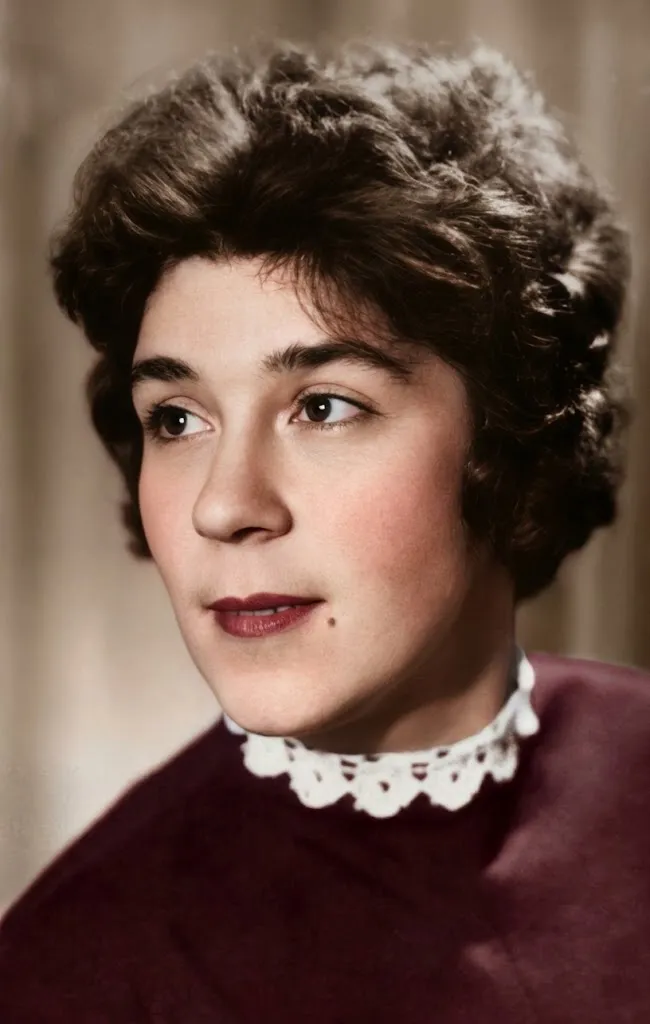
Emma Andiievska grew up in a Russian-speaking family, but the Ukrainian she heard in Vyshhorod enchanted her. As a child she decided to speak and write it, and later, though she mastered nine foreign languages, she wrote only in Ukrainian. Born in 1931 in Donetsk, then called Stalino, she moved with her family to the Kyiv region in 1937. In 1941 the Soviet authorities killed her father, and in 1943 her mother took Emma and her younger brother west. Andiievska published Poems, her first collection, in Neu-Ulm, Germany, in 1951, at the age of 20.
Andiievska graduated from the Ukrainian Free University. She lived in Germany and the United States and settled in Munich in 1961. For forty years, from 1955 to 1995, she worked for Radio Liberty’s Ukrainian service as an announcer, scriptwriter, director and editor. Her Ukrainian voice reached listeners across the Soviet border.
A dream world on the page
Andiievska used dreams and fantasy to make familiar things look different. She wrote sonnets, short fiction and novels. A Novel About a Good Person depicts the world of Ukrainian emigrants in postwar Europe. She also belonged to the New York Group, a circle of Ukrainian poets abroad. In 2018 she received the Shevchenko Prize for five poetry collections, including Drawer Landscapes and Time Without a Clock.
A dream world on canvas
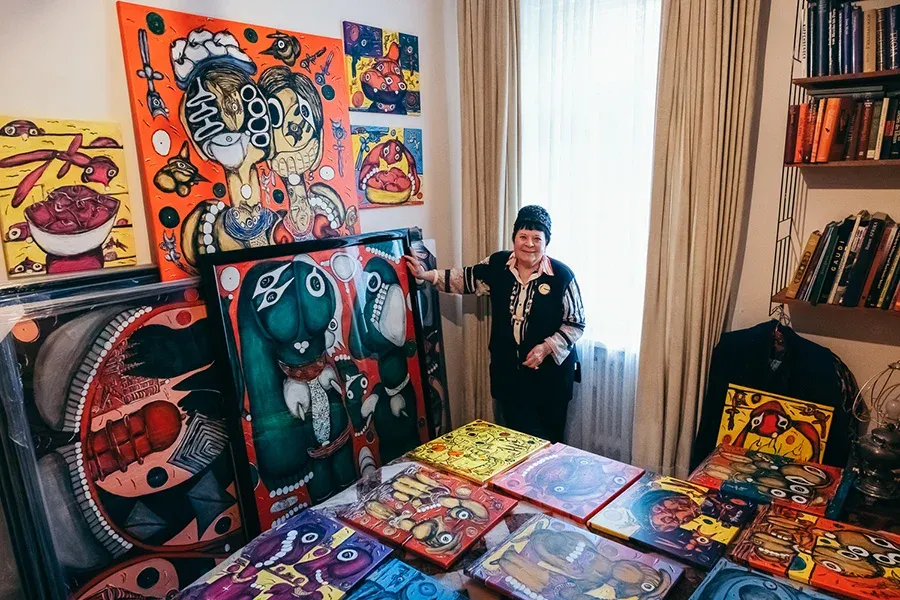
Painting became another language for her. Andiievska drew from early childhood: at six she illustrated Boccaccio’s Decameron. As a painter she made her debut in 1956 with an exhibition in Munich. In all she painted more than 9,000 pictures. They were shown in the US, Canada, France, Australia and Brazil, and from 1992 in Ukraine.
Her painting is called surrealist and hermetic: symbolic, fantastic worlds in which familiar things become unexpected. She painted her early works in watercolour and later ones mostly in acrylic and oil. She laid paint on a canvas again and again, sometimes up to twenty-five times. One of her favourite subjects is tea and a shared meal, and her paintings, like her writing, always carry a subtle humour.
Why it matters today
Andiievska did not inherit Ukrainian; she chose it, and she expanded what it could do in poetry, fiction and broadcasting, even when she worked far from Ukraine. Her work shows how much you can make in the language you choose for your own voice.