1926–2003
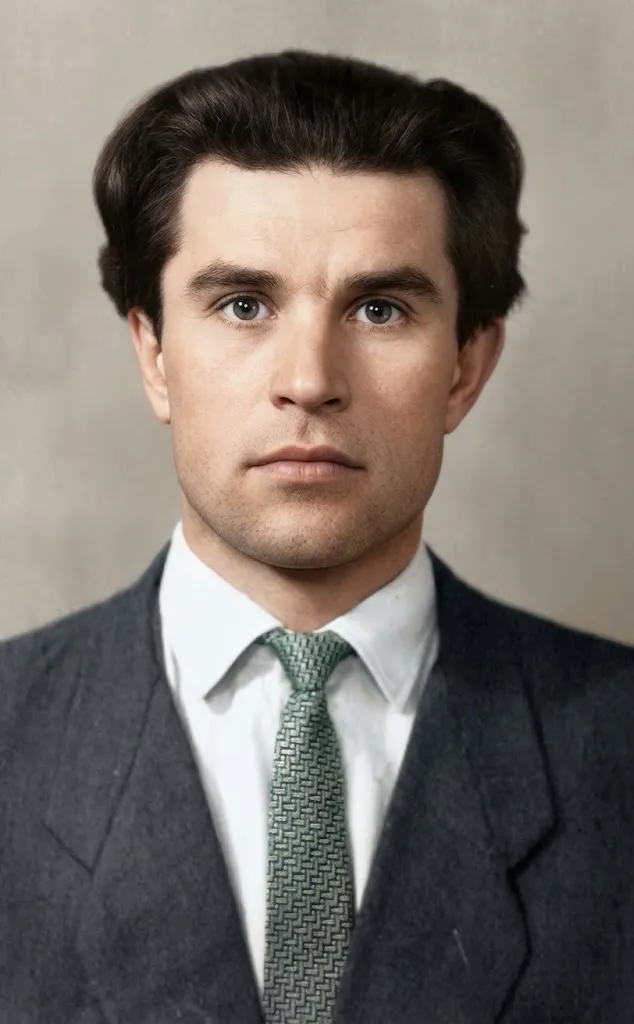
Oles Berdnyk
Science-fiction writer, rights defender
When the KGB took his two typewriters, Oles Berdnyk went 16 days without food, and the head of Ukraine’s Communist Party apologised to him in person. A classic of Ukrainian science fiction, he put Ukrainians among the stars, co-founded the Ukrainian Helsinki Group and was twice sent to camps.
Key accomplishments
- One of the founders of science fiction in Ukrainian literature: about 30 books, including The Star Corsair (1971) and the two-part Dazhboh’s Tuning Fork (1996)
- A founding member of the Ukrainian Helsinki Group (1976) and its leader from 1977; author of the group’s key documents, including the Manifesto of the Ukrainian Human Rights Movement (1977)
- The idea of an “Alternative Evolution”: open letters to the UN, the US Congress and the Vatican (1970s)
- Founder and leader of the humanist association Ukrainian Spiritual Republic (1989)
A hunger strike that ended in an apology
April 1972. The KGB searches Mykola Rudenko’s flat in Kyiv, where the writer Oles Berdnyk is living, and takes away Ivan Dziuba’s essay Internationalism or Russification? and two typewriters. Berdnyk refuses food for 16 days. Then Petro Shelest, the head of Ukraine’s Communist Party, receives him in person. Shelest apologises, but says the Party cannot interfere with the KGB. The typewriters come back. But from then on, his books stop being printed.
Sentenced for speaking up at a meeting
Berdnyk was born into a blacksmith’s family in Vavylove, in the Mykolaiv region; sources give 1926 or 1927. He volunteered for the front in 1943 and trained as an actor in Kyiv after the war. In 1949, at a meeting of his theatre, he protested that actors were denouncing their colleagues. He was arrested. At his trial he said he had been tortured during the investigation, and for saying so he was charged with “slander” as well. The sentence was 10 years in the camps.
Berdnyk later recalled that in the camp he planned to escape in a home-made hot-air balloon, but the plan was found out. In 1953 an escape attempt earned him another 10 years. He was pardoned in 1955.
Ukrainians among the stars
Once free, Berdnyk became one of the first Ukrainian science-fiction writers. According to Les Taniuk, he joined the Club of Creative Youth, the meeting place of the Sixtiers, on behalf of the writers. His heroes flew to the stars, and some of them were Ukrainians. Readers drew their own conclusion: if Ukrainians exist even in the distant future, then Russification is wrong.
The Star Corsair (1971) was soon pulled from libraries, yet village teenagers kept reading it for years. Berdnyk said he had hidden Christ, the eternal rebel, inside its hero. In 1976 a secret order had all his books removed from libraries and bookshops. The Writers’ Union expelled him, as it had the translators Mykola Lukash and Hryhorii Kochur, and Berdnyk went to work making stained glass.
When Rudenko was arrested
In 1976 Berdnyk founded the Ukrainian Helsinki Group together with Rudenko, Oksana Meshko and Levko Lukianenko. After Rudenko’s arrest he led the group and wrote the Manifesto of the Ukrainian Human Rights Movement.
In 1979 Berdnyk was arrested. Among the charges was his poem “Curse”, written for the 325th anniversary of the Pereiaslav agreement. The court gave him 6 years in special-regime camps and 3 years of exile. In 1982 he refused to testify against Mykhailo Horyn, and in 1984 he was pardoned.
A republic of the spirit
In 1989 Berdnyk became leader of the humanist association Ukrainian Spiritual Republic, and in 1991 he was put forward for president but not registered. He died in 2003. In 2006, for the Helsinki Group’s 30th anniversary, he was posthumously awarded the Order For Courage, First Class.
Debates and assessments
Before his pardon Berdnyk was twice taken from the camp to the KGB in Kyiv for “preventive talks” and “re-education”. In May 1984 the newspaper Literaturna Ukraina printed his “recantation”, which called the Helsinki movement a creation of the CIA. Some scholars write that he rethought the movement’s lessons and withdrew his support. Others hold that the recantation was forced. It “hurt deeply” his former comrades, and many never forgave him, though they acknowledge that his influence on young dissenters had been enormous. Some activists of the independence movement saw his idea of a Spiritual Republic as a distraction from the real struggle.
Why it matters today
Oles Berdnyk showed that science fiction can be a challenge to reality rather than an escape from it: in his universe, Ukrainians did not disappear. Teenagers grew up on his books, dreaming of the stars in Ukrainian. He stood at the start of the Helsinki Group, which demanded that the state respect human rights, and he paid for it with his freedom. His life speaks of courage, and of how hard it is to keep it under a system’s pressure. Anyone who writes about the future in Ukrainian walks a path he helped lay.