Ivan Kuchuhura-Kucherenko
Kobzar, bandura singer
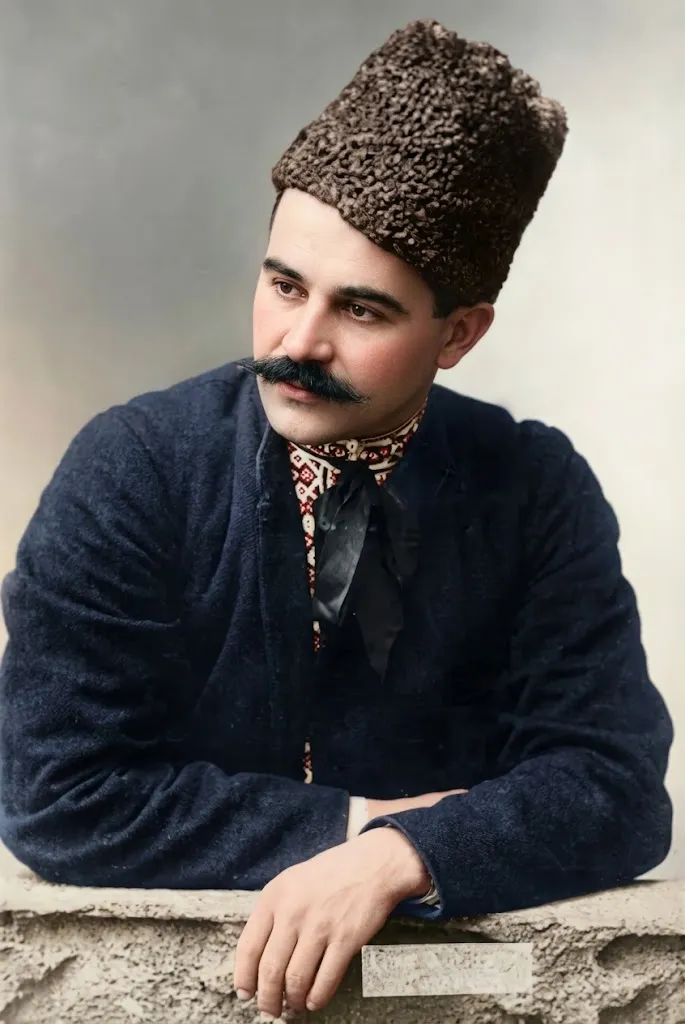
The historian Dmytro Yavornytskyi heard him at a market in Katerynoslav and called him "a precious diamond". Nearly blind, the kobzar Ivan Kuchuhura-Kucherenko sang dumas from Kharkiv to Warsaw and taught the bandura in Kyiv; in 1937 he was shot in Kharkiv.
Key accomplishments
- Performed at the 12th Archaeological Congress in Kharkiv (1902)
- Taught the bandura at Mykola Lysenko's School of Music and Drama in Kyiv (1908–1910)
- Dumas from his singing were transcribed and published by Filaret Kolessa in Melodii ukrainskykh narodnykh dum (Melodies of Ukrainian Folk Dumas, 1910–1913)
- Concerts in Kyiv, Kharkiv, Odesa, Katerynoslav, Poltava, Warsaw, St Petersburg and Moscow; gramophone recordings of songs and dumas (1912)
- His pupils included Vasyl Yemets, founder of the Kobzar Chorus (1918)
- People's Artist of the Ukrainian SSR (1925), a title taken away in the early 1930s
The boy who almost lost his sight
How do you become a kobzar when you can barely see the world? Ivan Kucherenko was born in 1878 into a peasant family in Murafa, a village near Bohodukhiv. As a small child he caught smallpox: it took the sight of his left eye and badly damaged the right, so all his life he walked with a guide. His father died early. Ivan learned to play the bandura and sing dumas, the old epic songs, from kobzars, first Stepan Bidylo and then Pavlo Hashchenko.
“A precious diamond”
Hnat Khotkevych put on a performance by kobzars and lirnyky (hurdy-gurdy players) at the 1902 Archaeological Congress in Kharkiv. The youngest of them was Kuchuhura-Kucherenko. In 1906 the historian Dmytro Yavornytskyi heard him at a market in Katerynoslav and called him “a precious diamond”. On his advice the kobzar spent three months in Myrhorod, studying with the artist Opanas Slastion.
From Kyiv to Warsaw
Kuchuhura-Kucherenko was invited in 1908 to teach the bandura at Mykola Lysenko’s School of Music and Drama in Kyiv. One of his pupils, Vasyl Yemets, went on to found the Kobzar Chorus in 1918. The ethnographer Filaret Kolessa wrote down dumas from his singing. The kobzar sang in Warsaw, St Petersburg and Moscow, and in 1912 he made records of songs and dumas. He performed dumas about Bohdan Khmelnytskyi and Oleksii Popovych and songs to words by Taras Shevchenko and Ivan Franko, and he dedicated a song of his own to Shevchenko, “Na vysokii duzhe kruchi” (“On a Very High Bluff”).
The banned kobzar
Kuchuhura-Kucherenko was made a People’s Artist of the Ukrainian SSR in 1925. But in the early 1930s the title was taken away and he was banned from performing; he got by weaving mittens, ropes and nets. In 1937 staff of the Kharkiv regional culture department denounced him for singing the “Petliura March” and religious psalms. Charged with belonging to a “counter-revolutionary organisation”, he was shot in Kharkiv on 24 November 1937. He was 59. He was rehabilitated in 1958.
Why it matters today
Kuchuhura-Kucherenko carried the dumas from village markets to the stages of big cities and showed that the kobzar’s art was alive, not just surviving. Kolessa’s transcriptions and the pupils who formed the first bandurist chorus brought his singing down to us. His fate shows that under Soviet rule even a song could be a crime. Anyone who picks up a bandura today carries on a tradition the regime tried to cut short along with his life.