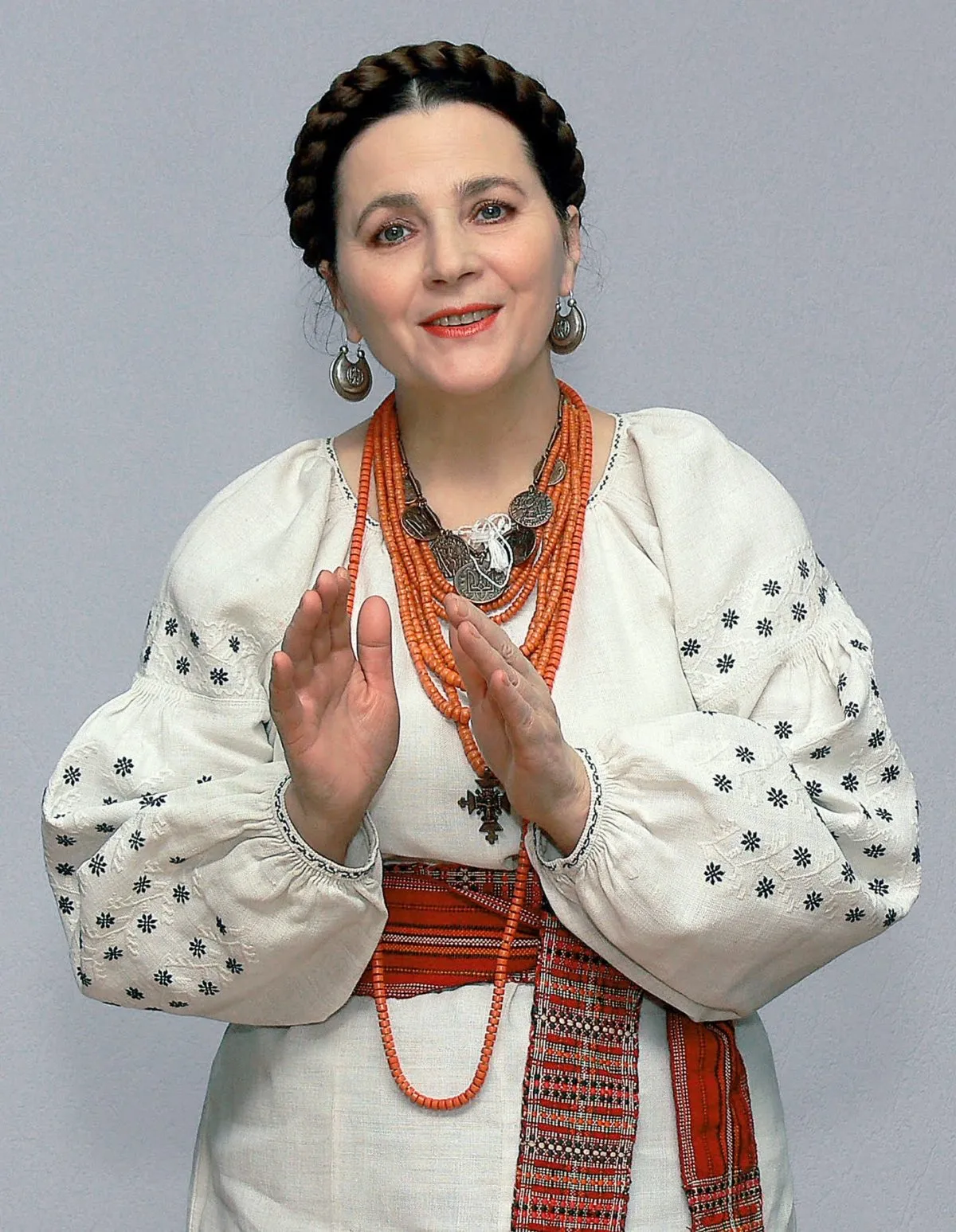
Nila Kriukova
Actress and spoken-word artist
How do you bring a banned poem to an audience? Nila Kriukova carried Ukrainian words onto the stage, then joined students fasting for Ukraine's freedom in 1990.
Key accomplishments
- Created 17 solo programs based on Ukrainian writers, despite Soviet censorship
- Prepared the one-woman show Marusia Churai with bandurist Halyna Menkush, then created a show based on Oles Honchar's Cathedral
- Was among the first performers to appear before the Chornobyl cleanup workers in 1986
- Joined the student hunger strike during the Revolution on Granite in 1990
- Received the Shevchenko National Prize in 1989 and the title Hero of Ukraine in 2008
How do you bring a banned poem to an audience? Nila Kriukova made Ukrainian literature a living performance, then joined students on Kyiv’s central square and fasted beside them. She was an actress at the National Philharmonic of Ukraine and a master of spoken-word performance who could turn a reading into an act of courage.
Seventeen voices from Ukrainian literature
In the 1970s, Kriukova prepared solo programs based on Ukrainian writers, despite Soviet censorship. She created 17 concert programs, performing prose, poetry, and dramatic works. In 1989 she received the Shevchenko National Prize for programs she had presented from 1985 to 1988.
A poem they tried to silence
With bandurist Halyna Menkush, Kriukova took on a one-woman show based on Marusia Churai, the poem by Lina Kostenko that Soviet authorities would not allow to be freely read. After pressure and edits by censors, the March 1982 premiere was moved from the Philharmonic to the Arsenal factory’s culture hall just half an hour before it began. Nearly five hundred people walked there, and the performance became a sign of solidarity among Ukrainian intellectuals. Kriukova later created a one-woman show based on Oles Honchar’s novel Cathedral.
Her voice after the disaster
In 1986, Kriukova was among the first to perform for cleanup workers in Chornobyl after the nuclear accident. She brought Ukrainian words to people working amid the disaster’s aftermath. Her concerts and theatrical programs later travelled across Ukraine and abroad.
On the square with the students
In October 1990, Kriukova joined the Revolution on Granite and fasted alongside the students. Her presence mattered to young protesters: a well-known actress was not just supporting them with words, but lying down on the granite herself. She recited a rallying cry she had written: “Ukraine, wake up; it’s time to win freedom!” Her participation showed that Ukrainian art and the struggle for freedom belonged together.
Why it matters today
Kriukova helped Ukrainian literature be heard where others tried to restrict it: she brought a banned poem to hundreds of people and Ukrainian words to the cleanup workers at Chornobyl. In 1990 she lay down on the granite beside young people fighting for freedom. Her example shows that an artist can stand with society beyond the stage, lending it a voice and acting alongside its people.