1849–1930
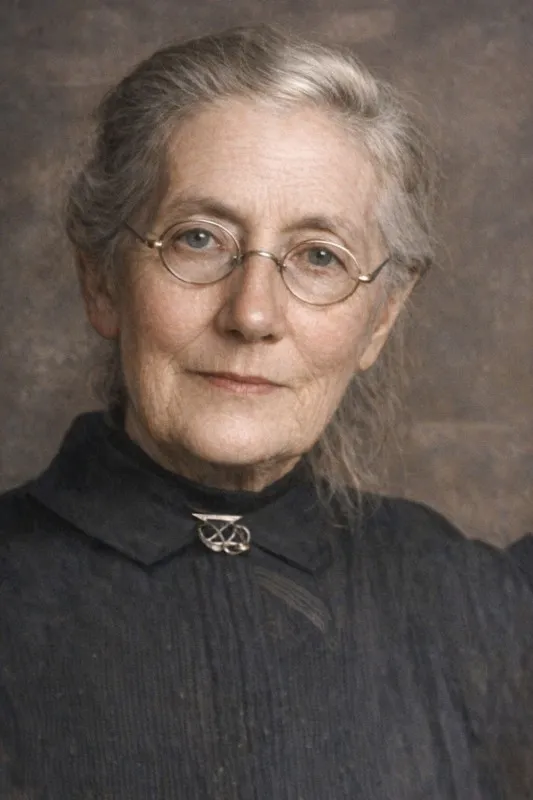
Olena Pchilka
Writer, ethnographer, publisher
She is often remembered only as Lesya Ukrainka’s mother and Mykhailo Drahomanov’s sister. Yet Olena Pchilka was a writer, ethnographer and publisher in her own right: she collected Volhynian embroidery, published Ukraine’s first women’s almanac and ran the magazine Ridnyi krai for eight years.
Key accomplishments
- Ukrainian Folk Ornament (1876), a study that grew out of the embroidery she collected in Volhynia; later Ukrainian Patterns (1912, 1927)
- The poetry collection Thoughts – Embroideries (1886); the stories Girlfriends, The Light of Goodness and Love, One and a Half Herrings
- Published the almanac The First Wreath (1887) with Nataliia Kobrynska
- Editor and publisher of the magazine Ridnyi krai (1906–1914) and its children’s supplement Moloda Ukraina (1908–1914)
- Plays for children; translations and adaptations of Ovid, Mickiewicz, Goethe, Andersen and Hugo
- Corresponding member of the All-Ukrainian Academy of Sciences (1925; other sources give 1927)
More than “Lesya’s mum”
Who was Olena Pchilka? Many people would say: Lesya Ukrainka’s mother. But she was also a writer, a scholar of folk art and a publisher. Olha Drahomanova was born in 1849 in Hadiach in the Poltava region, into a landowning family. Her older brother was Mykhailo Drahomanov. From 1861 to 1866 she studied at a girls’ boarding school in Kyiv and lived with her brother, who shaped her outlook. He brought her into the Kyiv Hromada, a secret Ukrainian society, where she met the composer Mykola Lysenko and the writer Mykhailo Starytskyi.
Embroidery from Volhynia
In 1868 Olha married Petro Kosach, another member of the Hromada, and moved with him to Zviahel (then Novohrad-Volynskyi). In 1871 their daughter Larysa was born, the future Lesya Ukrainka; in all, the Kosaches had six children. In Volhynia Olha wrote down folk songs, rites and customs and collected samples of embroidery. In 1876 she published Ukrainian Folk Ornament. Later the family lived in Lutsk and in the village of Kolodiazhne.
Ukrainian for everything
Pchilka began with translations, and from 1883 she published her own poems and stories in the Lviv magazine Zoria. Her first poetry collection, Thoughts – Embroideries, came out in 1886. Her stories were about the educated people of her day. She wanted to prove that Ukrainian could carry more than village life, nature and love: it could handle hard questions of philosophy, society and politics. In 1887, with Nataliia Kobrynska, she published The First Wreath in Lviv, the first women’s almanac in Ukraine.
Ridnyi krai
In the late 1890s the Kosaches settled in Kyiv. In 1905 Pchilka was one of the delegates of the Ukrainian intelligentsia who went to St Petersburg to demand an end to the ban on Ukrainian printing and schools. From 1906 to 1914 she edited and published the magazine Ridnyi krai (Native Land), and from 1908 also its children’s supplement, Moloda Ukraina (Young Ukraine). For children she wrote poems, fairy tales and plays such as Taras’s Spring Morning (1914); some were staged by a children’s amateur theatre she founded. She also translated Ovid, Mickiewicz, Goethe, Andersen and Hugo and wrote memoirs of Mykola Lysenko and Mykhailo Drahomanov.
The last years
In the early 20th century Pchilka lost her son Mykhailo (1903), her husband (1909) and her daughter Lesya (1913). She moved to Hadiach and took the editorial office of Ridnyi krai with her. In 1920 the Bolsheviks arrested her in Hadiach for “counter-revolutionary” speeches. After her release she lived in Mohyliv-Podilskyi, then returned to Kyiv and worked on the ethnography commission of the All-Ukrainian Academy of Sciences, which elected her a corresponding member. Olena Pchilka died in Kyiv on 4 October 1930. She was buried at Baikove Cemetery next to Lesya.
Why it matters today
Olena Pchilka proved that Ukrainian was not only a language for village songs but one for the hardest questions of her time. She wrote down and studied the embroidery, songs and rites of Volhynia, and that work helped keep them as part of Ukrainian culture. With Nataliia Kobrynska she gave Ukrainian women writers a book of their own, and her magazine for children showed that love for one’s language begins in childhood. Lesya Ukrainka grew up in exactly such a family. Anyone who writes in Ukrainian today about science, politics or philosophy carries on the cause she fought for.