1859–1916
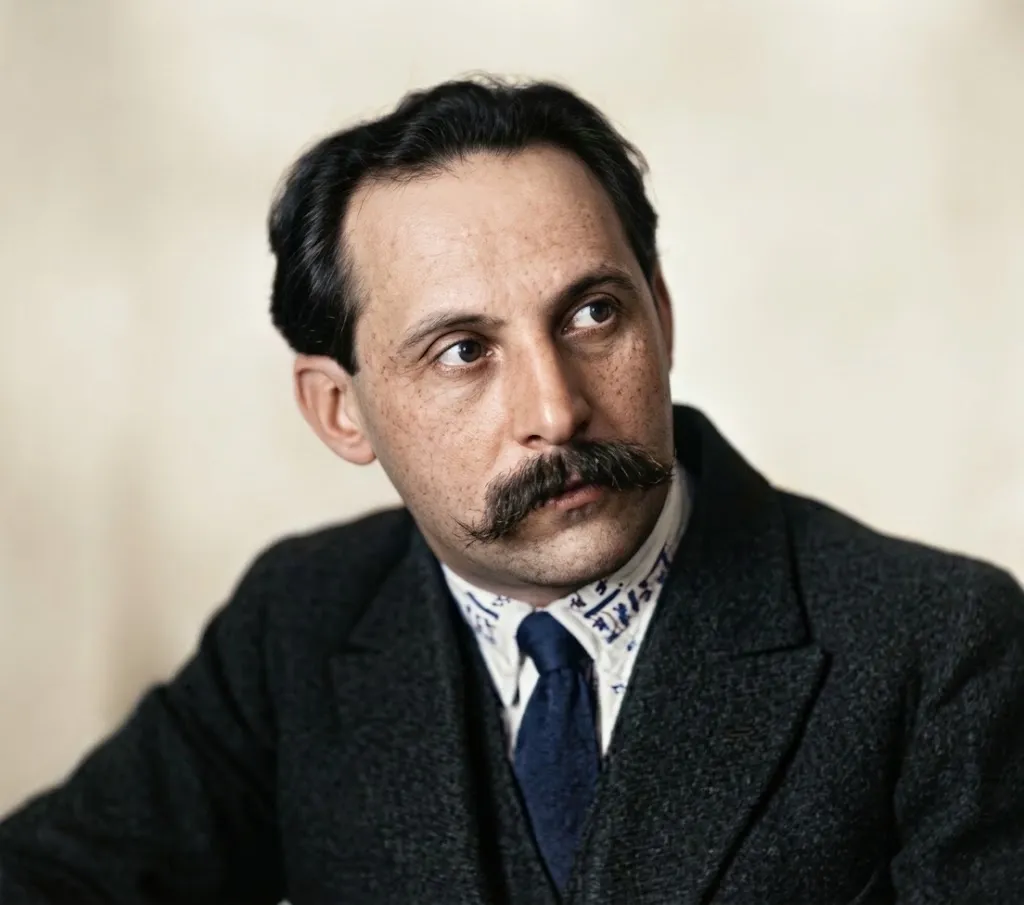
Sholem Aleichem
Classic of Yiddish literature
The Broadway musical Fiddler on the Roof grew out of stories about Tevye the Dairyman, who sold his milk to summer visitors near Kyiv. They were written by Sholem Aleichem, born in Pereiaslav, a classic of Yiddish literature whose characters live in Ukrainian small towns.
Key accomplishments
- The Tevye the Dairyman stories (1894–1914)
- Motl, the Cantor’s Son and the autobiographical novel From the Fair
- The novel Wandering Stars (1909–1911)
- The yearbook Di yidishe folksbibliotek (1888–1890), which brought together the best Yiddish writers
- His works have been translated into 64 languages
The boy from Pereiaslav
Sholem Rabinovich was born in 1859 in Pereiaslav, in the Kyiv region, into a Jewish shopkeeper’s family. He spent his childhood in the nearby small town of Voronkiv. Later he turned his memories of it into Kasrilevke, an invented town that became the image of the Jewish shtetl. He studied at a kheder (a religious primary school) and then at the Pereiaslav district school, which he finished with distinction. Around that time, still a teenager, he wrote his first story, in russian: A Jewish Robinson Crusoe. He gave russian lessons, and from 1877 he spent a few years as a tutor in the family of Elimelekh Loyev, a wealthy leaseholder, where he fell in love with Loyev’s daughter Olga. When the romance came out, he had to leave. In 1881–1883 he was the state-appointed rabbi in Lubny.
“Peace be with you!”
In 1883 his first works in Yiddish came out in a St Petersburg weekly, among them the novella Two Stones, a fictional retelling of his love story. That same year, over her father’s objections, he and Olga married. At the same time he first signed himself “Sholem Aleichem”: the everyday Yiddish greeting, literally “Peace be with you!”. Rabinovich wanted Yiddish literature to stand alongside literature in Hebrew. In 1888 he founded the yearbook Di yidishe folksbibliotek and gathered the best writers in it, among them Mendele Moykher Sforim and Isaac Leib Peretz.
Tevye, Yehupets and Boiberik
The first Tevye story came out in 1894. Tevye sells his milk to rich summer visitors in Boiberik, outside Yehupets. Sholem Aleichem invented these names for real places: Kyiv became Yehupets, Boiarka became Boiberik, Odesa became Chornomorsk, and russia was “Aunt Reyzl”. Most of his stories are set in Ukraine, with Ukrainian landscapes, Ukrainian words and folklore. He loved Ukrainian songs himself and kept Shevchenko’s Kobzar in his library. His heroes are poor “little people” who keep their humour and their faith in justice even in hard times.
From Kyiv to New York
In 1887 Rabinovich settled in Kyiv, played the stock exchange and within a few years went bankrupt. In 1903 he put together a collection called Hilf (“Help”) for the victims of the Kishinev pogrom and invited Tolstoy, Chekhov, Korolenko and Gorky to contribute. After the pogrom against Jews in Kyiv in October 1905 the family moved to Lviv, and in 1906 the writer went to New York for the first time. He travelled widely in Europe, reading to his audiences. In 1908, for his 25th anniversary as a writer, a jubilee committee in Warsaw bought back the rights to all his works from his publishers and handed them to him. That same year he fell ill with tuberculosis. In December 1914 Sholem Aleichem moved to New York for good. There he finished Motl and worked on From the Fair, a novel about his childhood. He died there on 13 May 1916. Hundreds of thousands of people came to his funeral. The New York Times printed his will, and it was read into the US Congressional Record. In it he asked his friends to mark the anniversary of his death by reading one of his merriest stories, and ever since, readers around the world have marked the day with readings from his works. He himself had wished to be buried in Kyiv, next to his father.
Ukraine in his books, his books in Ukraine
Sholem Aleichem was not simply born in Ukraine: most of his life passed here, in Pereiaslav and Voronkiv, Lubny, Kyiv and Odesa, and this is where he found all his characters. Tevye’s speech is full of Ukrainian words (cherede for a herd, khudobe for cattle, levade for a meadow, chernogus for a stork) and Ukrainian sayings. In the story “Passover in the Village” he told of the friendship between two boys, the Ukrainian Khvedko and the Jewish Faitl. Translations into Ukrainian began in his lifetime: in 1906 Ivan Franko printed the story “Uncle Pinye and Aunt Reyze” in the Lviv journal Literaturno-naukovyi vistnyk. Later Efraim Raitsyn translated many of his works, and Maksym Rylskyi translated his poem “Sleep, Oleksa”. Today there are Sholem Aleichem museums in Kyiv and Pereiaslav, a monument to him has stood in Kyiv since 1997, and streets in Kyiv, Dnipro, Lviv and Chernivtsi bear his name.
Why it matters today
Sholem Aleichem brought Ukraine’s small towns, Kyiv and Boiarka into world literature, under the names Kasrilevke, Yehupets and Boiberik. He was not only born here: Ukraine gave him his characters, his words and his songs, and Ukrainian literature took him in as one of its own, from Franko to the present day. Through his books, translated into 64 languages, and through Fiddler on the Roof, the world still sees these places and the people who lived in them. He showed that Yiddish could stand alongside Hebrew as a language of great literature, and that humour helps people keep their dignity even in poverty. His books are a reminder that the history of Ukraine is also the history of its Jewish towns. And when Bohdan Stupka played Tevye about 400 times in Kyiv, it showed that this legacy is still alive where it was born.