1866–1934
Mykhailo Hrushevskyi
Historian, head of the Central Rada
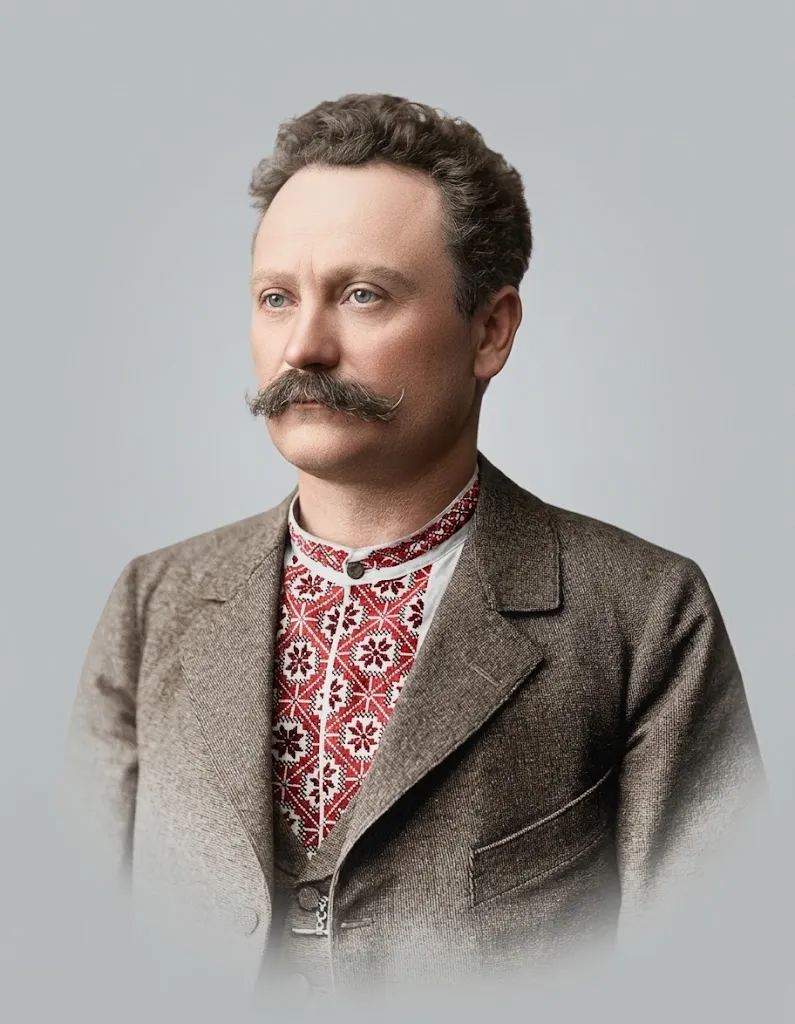
He wrote Ukraine’s history in ten volumes, then helped make it: under his leadership the Central Rada declared independence in 1918. Mykhailo Hrushevskyi is the historian without whom it is hard to imagine either Ukrainian scholarship or the Ukrainian state.
Key accomplishments
- The monumental History of Ukraine-Rus’ in 10 volumes
- President of the Shevchenko Scientific Society in Lviv (1897–1913)
- Head of the Ukrainian Central Rada (1917–1918)
- Proclamation of the independence of the Ukrainian People’s Republic by the Fourth Universal (January 1918)
Whose history is it?
For a long time the history of the Ukrainian lands was told as part of Russia’s. In his ten-volume History of Ukraine-Rus’, Mykhailo Hrushevskyi showed something else: Ukrainian history runs unbroken from Kyivan Rus’ to modern times, separate from Russia’s. That idea became the foundation of Ukrainian historical scholarship.
A professor in Lviv
Hrushevskyi was born in 1866 in the town of Kholm (now Chełm in Poland) into the family of an educator and studied at Kyiv University. In 1894 he took over a chair at Lviv University that became, in effect, the first chair of Ukrainian history. Under his leadership the Shevchenko Scientific Society grew into a true academy of sciences.
From autonomy to independence
In 1917 Hrushevskyi was elected head of the Ukrainian Central Rada (council). Under his leadership the Rada first proclaimed autonomy, and then, on 22 January 1918, by its Fourth Universal (proclamation), the independence of the Ukrainian People’s Republic.
In 1919 he emigrated, and in 1924 he returned to Soviet Ukraine. In 1931 he was forced to move to Moscow and arrested; after his release he lived under surveillance. In 1934 Hrushevskyi died suddenly in Kislovodsk after a minor operation, and the circumstances of his death still arouse suspicion.
Why it matters today
Hrushevskyi gave Ukrainians a scholarly history of their own people and led the Rada that proclaimed the Ukrainian People’s Republic. The Verkhovna Rada, Ukraine’s parliament, stands on a street named after him.