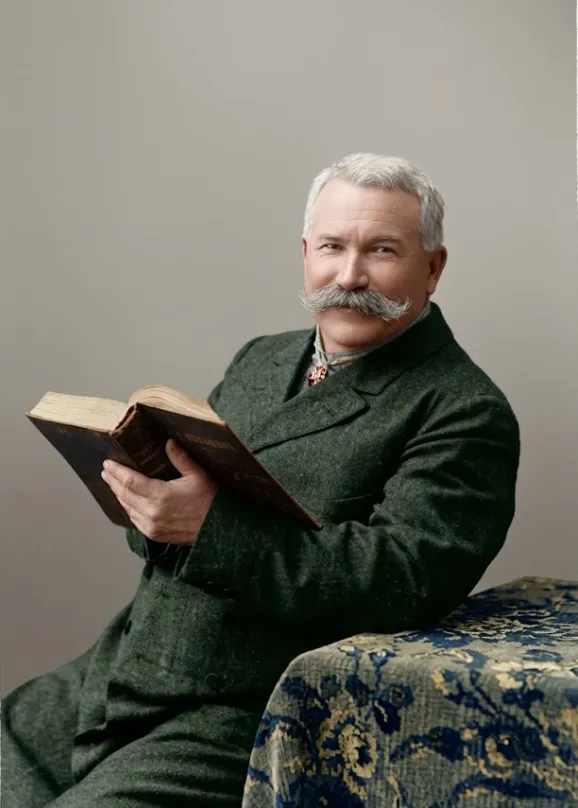
Mykola Arkas
Historian, composer, educator
An admiral’s son brought Shevchenko to the opera stage and Ukrainian history to a wider readership. Mykola Arkas helped build a Ukrainian cultural life in Mykolaiv, from classrooms to the Prosvita society.
Key accomplishments
- Kateryna, an opera based on Taras Shevchenko’s poem
- A popular History of Ukraine-Rus’ (1908)
- Organizer and head of Mykolaiv’s Prosvita society (1907–1909)
- Support for Ukrainian-language elementary education
An admiral’s son opens a history book
How do you make a country’s history accessible to someone without a university education? Mykola Arkas answered with a book written in Ukrainian for ordinary readers. His History of Ukraine-Rus’ appeared in 1908 and quickly found an audience. By then he had already composed an opera and supported Ukrainian-language schooling.
Arkas was born in Mykolaiv in 1853. His father was an admiral of Greek descent; his mother, Sofiia Bohdanovych, came from a Cossack family and encouraged his love of Ukrainian language and customs. Supporting Ukrainian culture became a cause to which he devoted his own money.
Music without a conservatory
Arkas’s degree was in natural sciences, earned in Odesa in 1875. He went on to serve in the naval administration in Mykolaiv. Alongside that career came folk songs, music and theatre. As a student he acted in amateur productions; Petro Nishchynskyi taught him music.
Without professional training as a composer, Arkas undertook a substantial work for the stage: Kateryna, based on Taras Shevchenko’s poem. He wrote the libretto himself, added plot lines and incorporated Ukrainian songs. A familiar poem gained a new musical voice.
A poem reaches the stage
Censorship delayed Kateryna’s journey to an audience. Arkas paid for the publication of its vocal score, the music for voices and piano, in 1897. In 1899 Marko Kropyvnytskyi’s company gave the first staging in Moscow. Productions followed on Ukrainian stages and in Warsaw and Kraków.
Arkas did more than set verse to music. He adapted the story to a theatre in which arias, choruses and action could reveal character. Kateryna remained his only opera.
A place to read Ukrainian
A bookshop, a reading room, a choir and an amateur theatre group: these were practical ways to build a cultural community. In 1907 Arkas helped organize Mykolaiv’s Prosvita society and became its head, serving until his death in 1909. It held performances and evenings with lectures on Ukrainian history and culture.
He also supported Ukrainian-language elementary education on his estates in the Mykolaiv region. The authorities closed a school he financed. His opera, educational work and society shared a purpose: to give people opportunities to learn and take part in culture in their own language.
Debates and assessments
A popular history and a scholarly study answer different needs. Arkas’s History of Ukraine-Rus’ introduced a broad readership to the past, but he was an amateur historian. Mykhailo Hrushevskyi sharply criticized its scholarly quality. Others, including Viacheslav Lypynskyi and Yevhen Chykalenko, took a more sympathetic view of its educational value. Its success does not remove the need to check its claims against modern scholarship.
Why it matters today
Arkas made more room for people to study, read history and hear opera in Ukrainian. His work connected local initiative in Mykolaiv with a shared Ukrainian culture. He brought his own skills and resources together with other people’s work. That kind of contribution can begin beyond any professional title, with a decision to support culture in practice.